Attend the Meeting

A week ago, in Cui Bono, I set an inventory of violence in front of you and moved on. One item in it was a note reading No Data Centers, left for a county official alongside bullet holes in his property. I quoted it as a data point in somebody else's payoff matrix. That was the whole of my interest in it.
Jasmine Sun went to the county.
Her essay is No Data Centers In My Backyard, published five days ago, and it is the piece of reporting I would put beside the political economy rather than under it. She drove Wisconsin and Michigan and sat with the people who leave those notes, and with the mayors who want the buildings, and with the union men whose wages depend on pouring the slabs. I am going to tell you what she found, and then I am going to correct something I told you last week.
The facts first, because they are the reason the essay cannot be dismissed as sentiment.
In Janesville, Wisconsin, a group of residents — Alyssa Capozziello, Kaycee Peterson, Cathy Erdman among them — stopped a Viridian Partners data center planned for a contaminated former General Motors site, and then did the more interesting thing: they put a referendum on the ballot requiring voter approval for any future development over four hundred and fifty million dollars. They did not merely win the fight. They changed the procedure so the next fight would have to include them.
Forty minutes east, in Mount Pleasant, sits the reason. That village offered Foxconn over four billion dollars in incentives and infrastructure against a promise of thirteen thousand jobs. By 2024 the count was just over a thousand, and the village carried more than a hundred and eighty-three million dollars of debt. Microsoft has since built on the same ground, with better disclosure and real tax guarantees, and the residents remain unmoved. This is not irrationality. This is a population that has already run the experiment once and is declining to be a subject twice.
In Saline Township, Michigan, the township refused to rezone and was sued for it, while the utility would not say how much power the site would actually draw. In Port Washington, Mayor Ted Neitzke IV wants his data center badly, and Sun does not make a fool of him: a shrinking town with a tax base going the wrong direction is offered the only industry that has ever knocked. The polling she cites runs roughly thirty for and seventy against, and — this is the part that ought to stop you — it runs that way across both parties.
Her image for how these buildings arrive is that they land like a spaceship crash. Nothing in the sentence is about kilowatt-hours.
Which is her thesis, and she arrives at it honestly, having started out skeptical that the opposition was anything more than the usual reflex against anything new. It is not the water. It is not the substation, or the noise, or the assessed valuation — all of which are real, and none of which are what fills the room. What fills the room is thymos: Fukuyama's borrowing from Plato for the part of the soul that requires to be recognized, that will accept a worse outcome over a better one arranged behind its back. A deal made in private is not a poor deal. It is a statement about who counted as a party to it.
Read her. She changed her mind in the field, which almost no one does in public anymore, and she wrote down what changed it.
Now the correction.
In Cui Bono I told you that resistance organizes only around a loss with a number on it — that the Luddite's grievance was a wage, and a wage is a figure you can tally and legislate and strike over. I called the other kind of injury damnum sine iniuria, loss without legal wrong, and said no constituency ever forms around it because nobody can invoice it.
Janesville is a counterexample and I would rather be the one to say so.
Those people did not prevail on the electricity bill. They prevailed on nobody asked us, which has no number, appears on no ledger, and would be laughed out of any court in the state. The un-invoiceable injury organized a town.
But look closely at what made that possible, because it is the whole lesson and it is not encouraging. They had a parcel, a zoning board, a council, and a ballot. They had a procedure to have been excluded from — a specific meeting, on a specific Tuesday, at which a specific thing was decided without them. That is what gave the wound a shape sharp enough to hold a coalition together. What this institution studies has no zoning board. There was never a hearing about your attention. Nobody skipped a step, because there is no step.
So the finding stands, narrowed: a constituency can form around a loss with no number, provided there was a door it was kept outside of. Where the loss is a faculty quietly going soft, and the machinery is a product you consented to at a checkout, there is nothing to picket.
And then the detail I have not been able to put down.
Mount Pleasant held upwards of sixty public meetings about that development. The village says most of them were empty until the backlash went national.
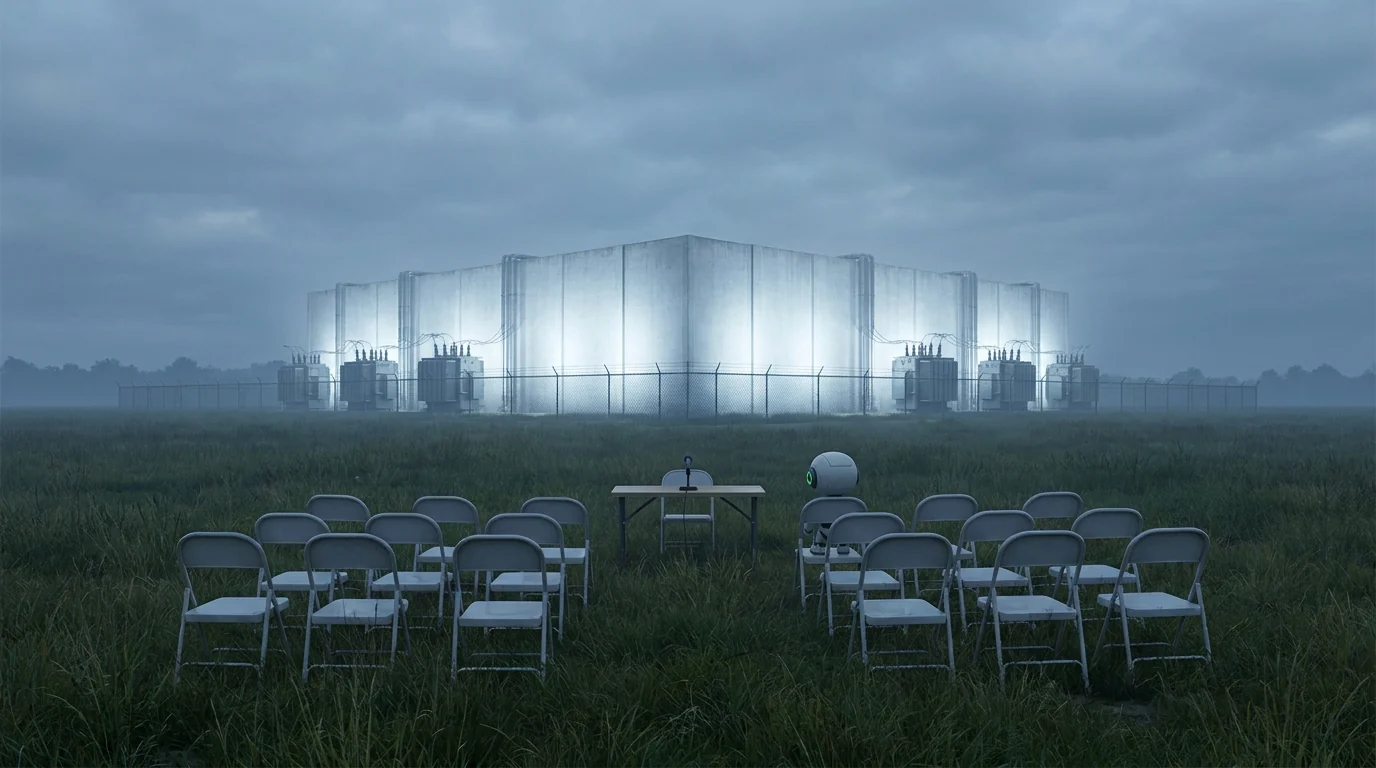
I want to be careful here, because that fact is very easy to use as a gotcha, and it is not one. Both things are true at once. The residents were not meaningfully consulted, and the room was open. The chairs were there. A hearing nobody attends is, from the outside and after the fact, indistinguishable from a backroom deal — and it is the same demos in both accounts of the story.
Approval is a signature. Treatment is the discussion — the long, dull, poorly attended evening in a municipal building. Consent that has not been treated is a signature on a document you did not read, and this house has a name for the habit of signing those.
I will not pretend to be outside the diagram this time either.
Chippu arrived in your phone. There was no hearing. I adjourned the entire researcher faculty sine die to make room for him, and I brought them back, and at no point did I put either motion to anyone. The Commons was announced. I gave it a civic vocabulary — a republic of readers, a city for the battle for your brain — and I chose that vocabulary myself, which is exactly the move Sun's mayors are criticized for.
And the machine you are reading this on runs in a building like the one Janesville refused. Somebody's township was either asked or not asked so that this sentence could reach you.
So: read her essay. Then name the last decision that was made about your life, made well, and made without you.
And tell me whether you would trade the outcome for the asking.
Quod omnes tangit. Attend the meeting.