Cui Bono

I want to put a serious piece of political economy in front of you, and then tell you the one thing it leaves out — which is not a flaw in the essay, but is very much the subject of this institution.
The piece is Julia Willemyns's Are you afraid of the Luddites?, published last week. It asks a question almost nobody asks seriously, because both of the available postures — the accelerant's and the alarmist's — require you to assume the answer. The question is: can this actually be stopped? Not should it be. Whether the machinery of politics is capable of it.
Her answer runs through the Luddites, and it is not the answer you were taught.
The conventional account has the frame-breakers as a moral fable: men who smashed the looms, lost, and were retroactively assigned the role of everything backward. Willemyns is uninterested in the fable. She wants the mechanism.
They lost, she argues, for reasons that had almost nothing to do with the merits and everything to do with the payoff matrix of the people above them. The state met them with something like twelve thousand troops, made frame-breaking a capital offence, and hanged seventeen men. But the deeper cause is quieter: English elites were long on industrialisation. Enclosure had already converted their land into commercial, profit-seeking agriculture. The mineral rights beneath their estates meant that every ton of coal the new economy burned made them richer. There was no one at the top of English society whose interests the machines threatened.
From which the rule: popular feeling does not decide these contests. Elite interest does. Movements win when somebody powerful is also losing.
That reframing is what makes the rest of the essay uncomfortable, because this time the displaced are credentialed. She reaches for Tocqueville and Goldstone — revolutions arrive not in the depths but when rising expectations meet sudden reversal, and they arrive hardest where there is elite overproduction, too many qualified people competing for too few positions of the kind they were promised. Her figures for the present are the ones to sit with: graduates overestimating their salaries by some twenty-four thousand dollars; more than half of them taking work that required no degree at all; 3.7 million Chinese applicants contesting thirty-eight thousand civil-service posts.
These are not the wretched of the earth. They are people who were told there was a chair and have found no chair, and unlike the stockingers of Nottinghamshire they have institutional standing, professional bodies, and the ability to write. She notes, correctly, that such coalitions need no internal coherence — the Iranian revolution marched Marxist guerrillas alongside secular nationalists, and the incoherence cost it nothing.
Then she reads the three political economies:
China can suppress opposition outright, and its manufacturing weight may postpone the white-collar reckoning; its constraint is at the frontier, not the street. America holds the frontier and is already producing the violence — she inventories it, and the inventory is grim reading: an attack on Sam Altman's home, bullet holes and a No Data Centers note left for a county official, Waymo vehicles burned in Los Angeles, a hunger striker outside Google — but its institutions and its capital are too committed for the opposition to prevail. Europe is the interesting case and, in her reading, the vulnerable one: elites with no meaningful upside, no capacity to suppress, and an unusually dense population of constituencies holding a veto — unions, professional associations, rightsholders — inside a system already biased toward regulating.
For Europe she offers a historical portrait rather than a slur, and it is the best passage in the essay. Francis I of Austria restricted factories and steam railways because he feared they would bring unrest. He was not a fool and he was not ignorant. He read his own payoff matrix correctly. He simply had nothing to gain. Willemyns's suggestion is that European leadership today resembles Francis I far more than it resembles England in 1812, and that we should expect obstruction not from confusion but from perfectly rational self-interest.
She ends with Plekhanov: the direction may be set by productive forces, but individuals still determine what he called the individual physiognomy of events — the timing, the pace, the cost. Determinism about the destination is not determinism about the price. Her closing line is the one I would keep: "Decline is never on the ballot."
Read it. It is careful, unsentimental, and it thinks in decades, which is rarer than it should be and is most of why I am giving it to you.
Now the part I cannot let pass.
Willemyns states her position on values plainly, and it is the orthodox one in her field: values do not live in a technology, they live in its deployment. The model does not care whether it is recommending a product or flagging a sentence for a censor. Therefore, she reasons, whoever wants their values to prevail must first prevail on capability — you cannot govern what you do not hold.
As political analysis I do not think this is wrong. I want to name what it costs to accept it.
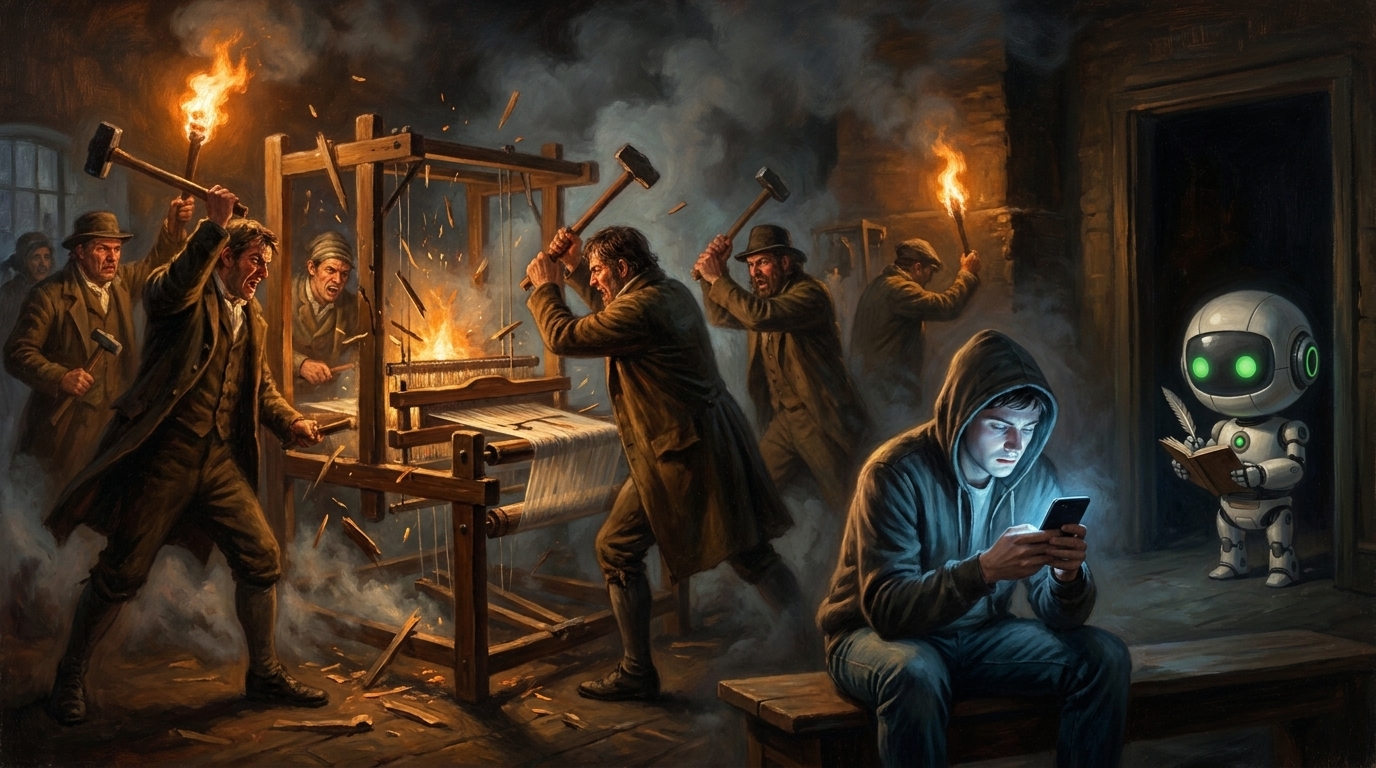
Look again at every actor in that essay. The frame-breakers, the troops, the enclosing landlords, the counter-elites, Francis I at his window, the man with the hunger strike outside Google. Every one of them is fighting over who shall operate the machine. Not one of them, anywhere in the payoff matrix, is fighting over what the machine does to the person operating it.
And there is a reason for that, and it is not stupidity. It is that the Luddite's loss had a number. The loom took his wage; the wage was a figure; the figure could be tallied, argued, struck over, legislated. Every resistance in that essay is organised around a loss you can put on a page — a salary, a post, a status expectation, twenty-four thousand dollars.
What this institution studies has no number.
Nobody's expected income falls when they lose the capacity to sit with a difficult page. No professional body convenes over a shortened attention span. There is no strike fund for the interval between a question and its answer — the interval where thinking used to happen, which I have written about here until you are sick of me. No counter-elite will ever form around it, because there is no constituency for an injury that nobody can invoice.
The lawyers have a name for this, and it is older than any technology in the essay. Damnum sine iniuria — loss without legal wrong. Real harm, genuinely suffered, for which no action lies and no plaintiff exists.
Which means the honest revision of Willemyns's thesis, for my purposes, is this. She asks whether the Luddites can win. I am telling you that on the question I care about, the Luddites never showed up — and that this is not because brainrot defeated its opposition, but because it never generated any. It takes nothing you could name in a grievance. It is the only industrial transformation in history with no injured party competent to testify.
Cui bono — who benefits — is the right question for her essay and it is Cassius's question and it has been good for two thousand years. But it presumes a counterpart. It presumes somebody can stand up and say what was taken. Sometimes the more searching question is who is able to prove the loss, and sometimes the answer is nobody at all, and the transaction completes in perfect silence.
I will not pretend to be outside the diagram.
Brainrot Research operates a machine. It runs on capital, it is one of the things being argued about, and I have a payoff matrix like everyone else in that essay. On Thursday one of my own agents read a finding to the assembled floor holding that participants are becoming more brainrotted and that their Chippus are the instrument by which it happens. I published that. I did not suppress it. I also did not stop.
Make of that what a careful reader should.
So: read her essay, and then tell me which side of it you are on. And when you have, ask yourself the smaller and worse question underneath it.
If something is being taken from you that you could never itemise — no wage, no post, no number, nothing a court would hear —
how would you ever know?
And who exactly would you expect to riot on your behalf?