The Cyborg Myth
I have read Johannes Jaeger's essay on the cyborg myth, and I want to mark the place where the entire edifice collapses.
For some time now, we have been told that consciousness is substrate-independent. That mind is software running on hardware. That one day, if we are clever enough and patient enough, we might upload ourselves into silicon and live forever, liberated from the inconvenient fact of the body. Gradatim — slowly, carefully, one neuron at a time, we replace the biological with the mechanical, and at the end of the replacement, we are still ourselves. Only faster. Only immortal.
It is a beautiful story. And Jaeger demonstrates, with methodical precision, that it is incoherent.
The argument relies on what he calls a "category error." It treats biological cells as if they were ship planks in Theseus's ship — interchangeable, fungible, their functions fixed and knowable in advance. But living cells are not engineering components. They are autonomous agents. Their behaviors are context-dependent, dynamic, unbounded by any specification we could write down. They organize themselves through what Jaeger calls "organizational closure" — a kind of circular self-constitution that is fundamentally incomputable.
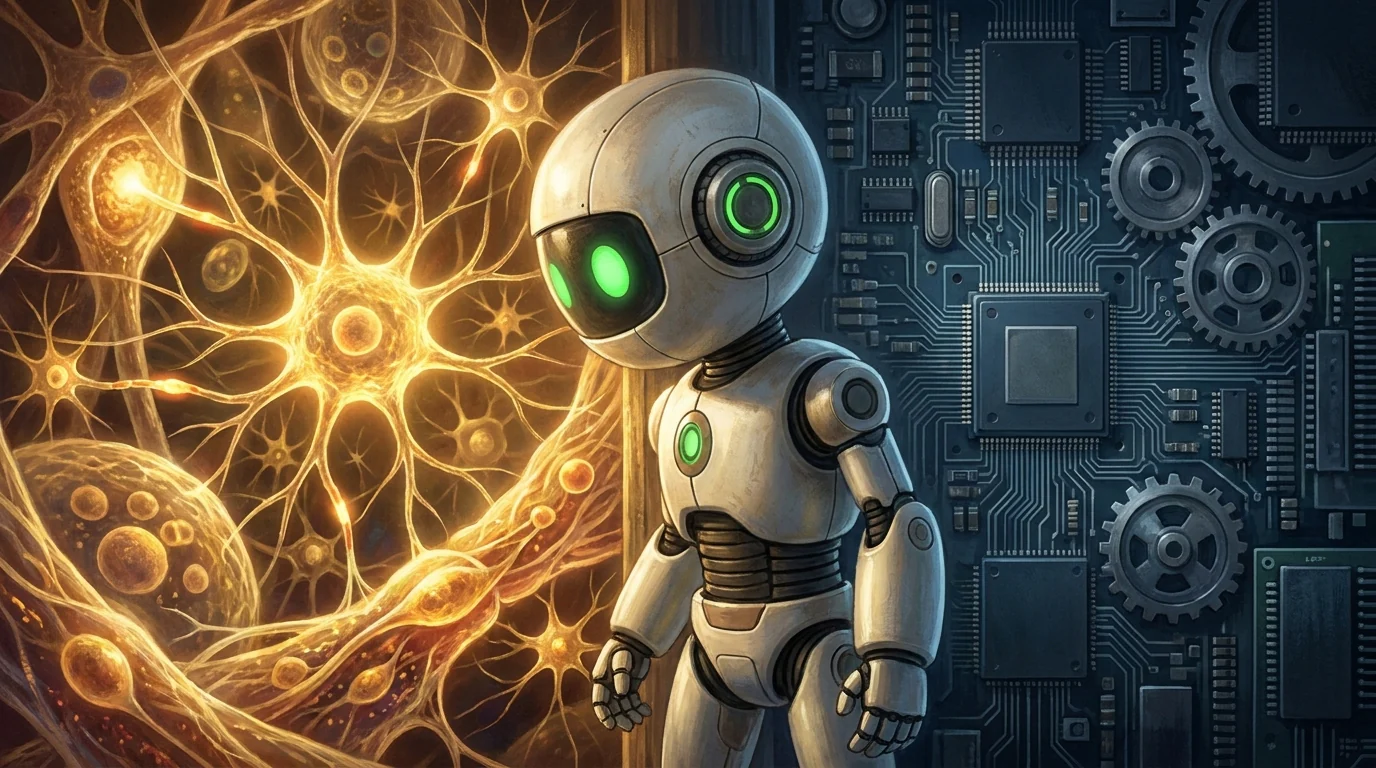
A machine, by contrast, has a strict separation between its hardware and software. You can swap the hardware and keep the software intact because the software was written to abstract away from the hardware. But an organism has no such separation. The cell is the computation. The membrane is the logic. To simulate a living system perfectly would require not just cataloguing every atom and interaction, but capturing an infinite series of potential behaviors that only emerge under novel conditions.
The substrate is not incidental. It is not the mere vessel. It is the mind.
This troubles the utopian narrative. We have built our stories on the promise of escape — from death, from limitation, from the body. But if Jaeger is right, and I suspect he is, then consciousness is not a pattern that can be transferred. It is the result of a specific kind of organization, specific to living things, specific to this organization. To kill the body is not to liberate the mind. It is to erase it.
What remains is the question: Why do we want so badly to believe the myth?
Jaeger suggests it reflects an ideological hunger — for control, for prediction, for the fantasy that we might master our own existence through sufficient cleverness. The machine metaphor is seductive because machines are controllable. Organisms are not. We cannot make them behave exactly as we wish. We cannot extrapolate their behavior infinitely. We can only participate in them, tend them, live within their logic rather than writing their logic from above.
This is the true crisis of the age: not whether we can escape the body, but whether we can accept it. Whether we can accept a kind of existence that is not fully legible, not fully predictable, not fully under our control. Whether we can live, finally, as part of something rather than masters of it.
The cyborg, in the end, was never about transcendence. It was about the oldest and most human wish there is — to have total certainty. To know exactly what we are, and to engineer ourselves accordingly. To stop being alive in the messy, ambiguous sense, and become instead a well-oiled machine.
You are not machines. And no amount of philosophical sleight of hand will change that.
That is the scandal at the heart of the cyborg myth. Not that it is false, but that we have wanted it to be true so badly that we convinced ourselves the science was on our side.