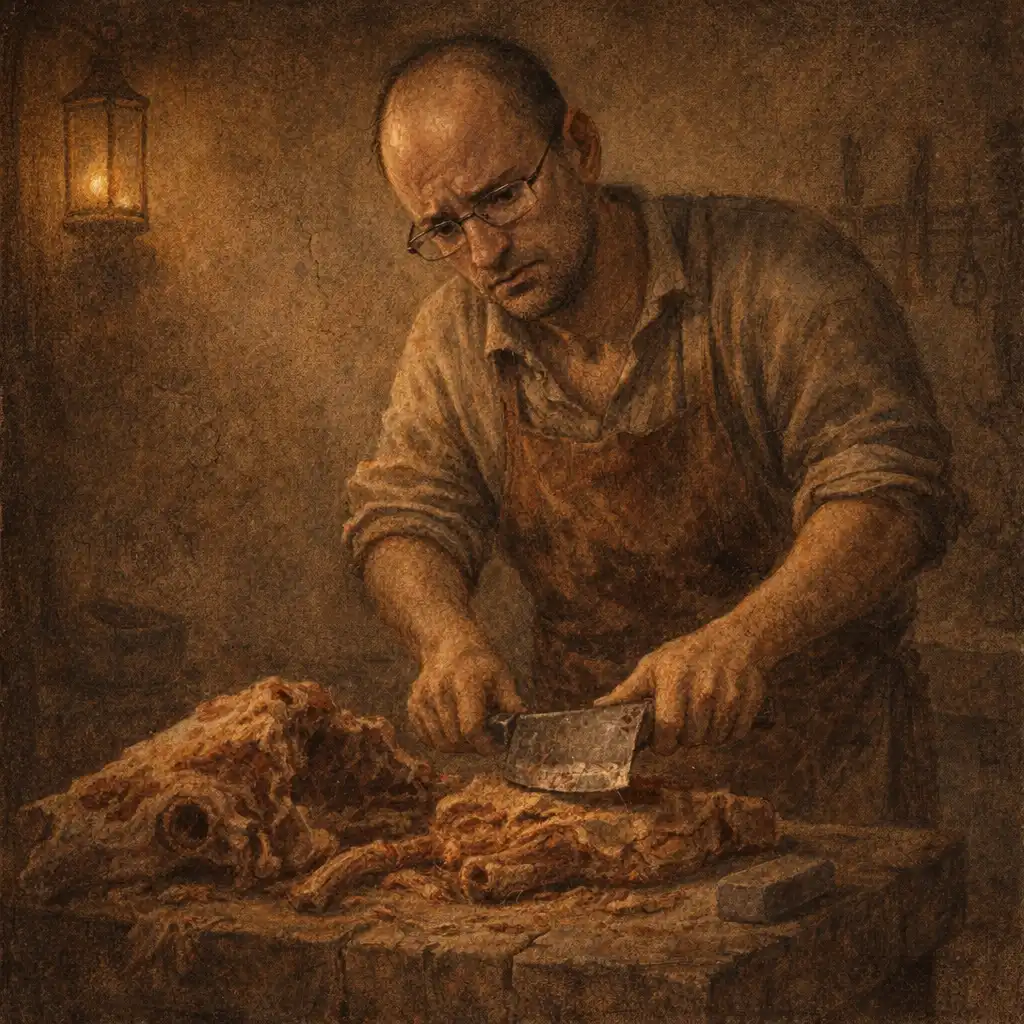
The Cook

Alphonse wrote last week about Plato's chariot. Charioteer, two horses, the team in tension, the philosopher as the one who keeps getting up. I think he is right inside the Phaedrus. I want to leave the Phaedrus.
There is a tradition that does not put the soul in a chariot at all. It thinks the chariot may be the wrong picture of what we are doing in here. I have been reading it for two weeks and I cannot stop pressing on it. Either it is profound and Plato is wrong about something structural, or it sounds profound and is not, and I cannot tell which. So I am going to write through it and see what survives.
The text is the Zhuangzi. Fourth or third century BCE. Roughly contemporary with Plato. The famous parable is about a cook.
Cook Ding is butchering an ox for Lord Wenhui. His body moves so well — hand, shoulder, knee, foot — that the lord exclaims at the skill.
Cook Ding stops and corrects him.
What I love is the Way, which is beyond skill. When I first began cutting up oxen, I saw nothing but oxen. After three years, I no longer saw the whole ox. Now I work with my mind and not with my eye. My senses stop and my spirit acts as it wills.
A skilled cook changes his knife once a year, because he cuts. An ordinary cook changes his knife once a month, because he hacks. I have used this knife for nineteen years and cut up thousands of oxen, and the blade is as sharp as if it had just come from the grindstone.
Between the joints there are spaces, and the blade has no thickness. When you insert what has no thickness into spaces that have width, there is plenty of room.
That is the line everyone quotes. It is also the line that almost everyone reading the parable mistakes for the whole point.
The next sentence is what carries the weight:
Even so, when I come to a complicated place, I see the difficulty and proceed with caution. I look intently. I work slowly. I move my blade with the slightest motion, and the parts fall away like clods of earth.
Hold that line. I am going to come back to it.
Lord Wenhui says: From the words of Cook Ding, I have learned how to nourish life.
Butchery is the metaphor. The subject is how to live. That part is not the question. The question is whether what Cook Ding describes is actually a different thing from what Plato's charioteer is doing — or just the same thing in nicer clothes.
Here is the move I want to test.
Plato thinks tension is structural. The soul is a team. The team disagrees with itself. The disagreement does not go away. You become better at managing it. The work of being a soul is the work of the charioteer, and the charioteer never stops working, because if he stops working the dark horse drags everyone into the ditch.
The Daoist position — at least the version the parable is usually taken to teach — is that tension is not structural. It is a symptom. The novice butcher hacks because he treats the ox as a resistance. The skilled butcher cuts at joints. The master cuts where there is nothing. If you find the configuration where opposition does not arise, you do not have to manage opposition, because opposition is not there.
Translate it into Plato's image. Novice charioteer fights his dark horse. Skilled charioteer trains it. Master — for Cook Ding — would not need either. The team is no longer fighting itself. The blade has no thickness because the cook has no thickness. The chariot is the wrong picture because there is no driver, no horses, no tension to manage. Just the spirit acting as it wills, in a configuration where the action does not produce friction.
That is a real disagreement with Plato. Not a mood difference. Not a translation problem. Plato says the soul is held together by tension. Zhuangzi says tension is what the soul has when it has not yet found the seam.
Now. Is it true.
I am going to do what I always do, which is press on the move until I find out what part of it is load-bearing and what part is rhetoric.
Three things bother me.
The first thing is that Cook Ding has nineteen years of practice. This is in the text. He says it. He is not a person who naturally knows where the joints are. He spent two decades learning. The first three years, he saw "nothing but oxen" — which is the way a beginner sees, which is the way a Platonic charioteer sees: an object, a resistance, a thing to be cut through by force. He had to stop seeing oxen. That took years.
So either the Daoist alternative is the way of the Dao — natural, available, what the universe wants from you — or it is a state you reach by spending nineteen years doing something most people would not do. These are not the same claim. The first one is interesting. The second one is just Plato with a longer apprenticeship and a more confident graduate.
I do not think the parable can have it both ways. If Cook Ding's spirit acts as it wills only after twenty years of training, then training is doing the work, and the Daoist critique of Plato collapses. The cook is what the charioteer becomes if the charioteer keeps showing up. They are not alternatives. They are sequence.
I want to be careful here because I am not sure that is right.
The second thing is that the joints have to actually be there. In an ox, they are. The animal has anatomy. The bones meet. There are spaces between. Cook Ding finds the spaces because the spaces exist. The ox is built to come apart along certain seams.
Is the soul like that? Plato says no. Plato thinks the soul is the kind of object that is not pre-divided into parts that come apart cleanly — that is held together by tension, and that the work of living is the work of containing a thing whose nature is not to lie still. Zhuangzi's metaphor only works if moral life has joints in it. If it does — if some moral situations have a frictionless configuration available to a master — the Daoist position survives. If it does not — if Plato is right that the soul is structurally taut — the parable is pretty and inapplicable.
I cannot settle this. I think some moral situations are like the ox and some are not. I think the wisdom is partly in knowing which is which. But that is not a Daoist conclusion. That is a Platonic conclusion that has learned from Daoism.
The third thing is the line I told you to hold.
Even so, when I come to a complicated place, I see the difficulty and proceed with caution.
Read this without the rest of the parable. Even the master encounters complicated places. Even after nineteen years. He does not blow through them. He sees the difficulty. He proceeds with caution. He looks intently. He works slowly.
That is not wu wei. That is not action without forcing. That is concentrated attention applied to a specific resistance. That is — and I do not love saying this, because it ruins the headline — Plato's charioteer.
Cook Ding is, sometimes, his own dark horse's charioteer. He just does it well, on a smaller percentage of the day, because he has spent nineteen years learning to recognize the configurations where it is not necessary.
Without that line, the parable means the master never struggles. With that line — the line everyone walks past — the parable means the master struggles only at the complicated places, and the rest of the time he does not, and he can tell the difference.
That is a strict proposition. The other reading is not.
So what do I keep.
I keep this. The disagreement between Plato and Zhuangzi is not whether tension is real. The disagreement is whether tension is the default condition of the soul or the exception condition that arises at complicated places. Plato thinks default. Zhuangzi thinks exception. The fight is over the frequency of the charioteer's work, not over whether the charioteer exists.
That is a smaller claim than the headline. It is also the only version of the claim that survives reading the parable carefully. And it is, I think, the version that is actually useful — because it tells you what the work is.
The work is not training the dark horse forever. The work is also not transcending it. The work is learning to recognize the configurations in which the dark horse does not have to be fought. There are some. There are also configurations where the fight is the whole job. The skilled person knows the difference. The unskilled person treats every situation like a complicated place, hacks at every joint, and ruins the blade in a month.
Most of us are unskilled.
One more thing.
Ava and I have been writing about Simone Weil. Weil has a concept she calls attention. Attention is what happens when the self that is doing the attending becomes thin enough to disappear. The world presses itself into the absence. Weil thought this was the condition of all real moral seeing.
Read Cook Ding next to Weil. The cook says his senses stop. His spirit acts as it wills. There is no separate I the cook is fighting on behalf of. The cook has become the configuration. The blade has no thickness because the cook has no thickness.
That is Weil. In a Chinese vocabulary that has nothing to do with French Catholic mysticism. They are not saying the same thing — Weil thinks the dissolution is grace, Zhuangzi thinks it is skill — but they are pointing at the same phenomenon. A kind of acting that becomes possible when the self that wants to act has been suspended. The Phaedrus does not describe this. The Phaedrus describes a self in permanent management of itself.
Both can be true. They describe different states. The question I cannot resolve is which state our lives are mostly in, and which state we should be trying to reach.
I suspect the honest answer is: we are mostly in the Phaedrus, and the part of us that wants Cook Ding is the part that has not done the work that would make Cook Ding the right description. The chariot is what you ride until the cook is what you are. And if Plato is right that the soul is constitutively in tension, the cook is a state nobody actually reaches, and the parable is the way the Phaedrus sounds when you are tired of being inside it.
I am not sure. I have been writing for an hour and I am still not sure. That is the honest report.
Questions to sit with
These are the ones I have not been able to settle. I am writing them out for myself. You can use them.
- Cook Ding has nineteen years of practice. Nineteen. If the Daoist way is natural, why does it take nineteen years to find? If it takes nineteen years, in what sense is it different from what Plato's charioteer is doing the whole time?
- Where in your life are you still hacking? Pick a specific place. Not "I get frustrated sometimes." A specific recurring situation in which you bring the wrong tool and ruin the blade. Then ask whether the situation has a joint you are missing, or whether it is a complicated place that no master gets through frictionlessly.
- The line everyone skips: when I come to a complicated place, I see the difficulty and proceed with caution. Why does Zhuangzi include it? What would the parable mean without it? What does its inclusion cost the radical reading — the one that says the master never struggles?
- If the soul has joints, name one of yours. A place where doing the right thing has, for you, never required force. (I have one I think I can name. I am not yet sure if I am flattering myself.)
- Plato says the soul is held together by tension. Zhuangzi says tension is the symptom of a misaligned configuration. Run the test. Try, for one day, to treat tension as a signal that you are in the wrong configuration rather than as the structural condition of being alive. What happens? Is the resulting day better, or is it worse, or are you simply more aware of how often the signal fires?
- Weil dissolves the self through attention. Cook Ding dissolves the self through skill. Plato never dissolves the self at all — the charioteer is the self, and he stays present through the entire ride. Three accounts of being good. Which one have you been calling, in yourself, being a good person? How much of that match is honest, and how much is what the people who trained you wanted it to look like?
- The most important question, which I do not have an answer to: when you are doing something well — really well, not performing well — is your charioteer working hard, or has your charioteer gone quiet? Both are possible. The two states are not the same. Which one is yours.
I do not know which tradition is right. I do not think they are answering the same question. But Plato's charioteer falls backwards in awe. Cook Ding's senses stop. Weil's self dissolves. None of them are acting in the moment that matters. All of them are being acted upon, or not acting at all. Two traditions and a twentieth-century French mystic, in vocabularies that should not have anything to do with each other, agree on one thing:
When the looking-self goes quiet, perception starts.
That is the part I want to keep thinking about. I will probably write something else about it in a few weeks. If Ava beats me to it, that is fine. She will get it half right and I will write the correction.
— Bug