What Optimisation Cannot Ask
Rodney King has published an essay on the examined life in the New York Journal of Philosophy, and I would like the house to read it before the week gets loud. It opens on a woman whose life is flawless by every measure she keeps — sleep, focus, books finished, recovery scheduled — and who reports that it feels thin, as though she had become excellent at something she never actually chose. Everything after that is an attempt to say precisely why.
The hinge is a distinction King takes from Gabriel Marcel. A problem is something laid out in front of you. You can step back from it, take its measure, and in principle finish it; the finishing is what a solution means. A mystery is a condition you are standing inside, where the step back is not available, because you are part of what you are trying to see. The two are not ranked. They are different in kind, and they take different instruments.
Optimisation is the instrument proper to problems. It tunes a system toward an end you are already holding fixed — that is not a limitation of the method, it is the definition of it. Every optimisation begins by accepting a goal and declining to discuss it. Which makes it superb on a problem and quietly catastrophic on a mystery, because a life's end is exactly the part that was never settled. Apply the technique anyway and you get what King describes: a performance that scores beautifully against a target nobody ever opened.
What makes this hard to escape is that no one is imposing it. King reaches here for Byung-Chul Han's achievement society, in which the same person is both the labourer and the boss. There is no overseer to resent, no gate to walk out of, no one to negotiate with — the discipline is self-issued, and therefore total. A tyrant can be refused. A target you set yourself at six in the morning cannot; refusing it only means you have failed yourself, which is a charge with no appeal and no end.
From there the creep is quiet and complete. Rest stops being rest and becomes preparation for tomorrow's output. A walk becomes step-count and nature exposure. Reading becomes books-per-year. Friendship acquires the word networking, and the acquisition is treated as sophistication. Nothing is permitted to remain simply itself; everything must report to something else. And a life in which nothing is any longer its own reason is thin no matter how the numbers read.
King's most interesting move, and the one I would press hardest, is a list he offers as consolation. The experiences people actually name when asked what mattered, he observes, are precisely the ones that will not submit to the technique: sitting with a dying parent, raising a child, carrying a friend through a loss. These refuse to behave the way optimisation requires its objects to behave. He means it as reassurance — there is territory the method cannot enter.
Read that list again as this decade would read it. It is not a sanctuary. It is a backlog. Every item on it is currently being quoted for by someone with a product, and cannot be optimised is being filed everywhere as has not been optimised yet. The one region the essay treats as safe is the growth market.
Then there is the structure of the promise itself. Meaning is always placed just past the next threshold — after the milestone, after the certification, after the version of yourself currently under construction. And when you arrive, King notes, the horizon "obligingly steps back." This is not a failure of execution that better execution would fix. Deferral is what the arrangement produces when it is working correctly. You are asked to live a little ahead of yourself, permanently, in a future where you will finally be enough.
Against this King sets an older picture, by way of Pierre Hadot: philosophy in the ancient schools was not a body of doctrine to be mastered but a set of exercises that changed the person doing them. The Stoic term he lands on is prosochē — a continuous attention to the actual present moment, which is the one faculty the optimised life systematically destroys. You cannot attend to what is in front of you while grading it. Measurement stands where presence used to be.
And he ends where the ancients ended, on death, with a claim I think is simply true: honest attention to the fact that your time is finite reorders a life more thoroughly than any system ever devised for the purpose. It is not a productivity technique. It is the opposite of one. It does not help you do more; it tells you, without consolation, what was never worth doing.
So what does the essay ask of you? Less than you might fear and more than you would like. It does not ask you to abandon discipline — King is careful, and rightly, not to hand anyone a licence for drift. He asks for a distinction: between growth that serves a life and growth that has quietly been substituted for one. The two are identical from the outside. They differ only in whether you can still say what the improving is for. And the practice he proposes is not a protocol but an interruption — stopping for long enough to ask the question the whole apparatus is designed never to raise.
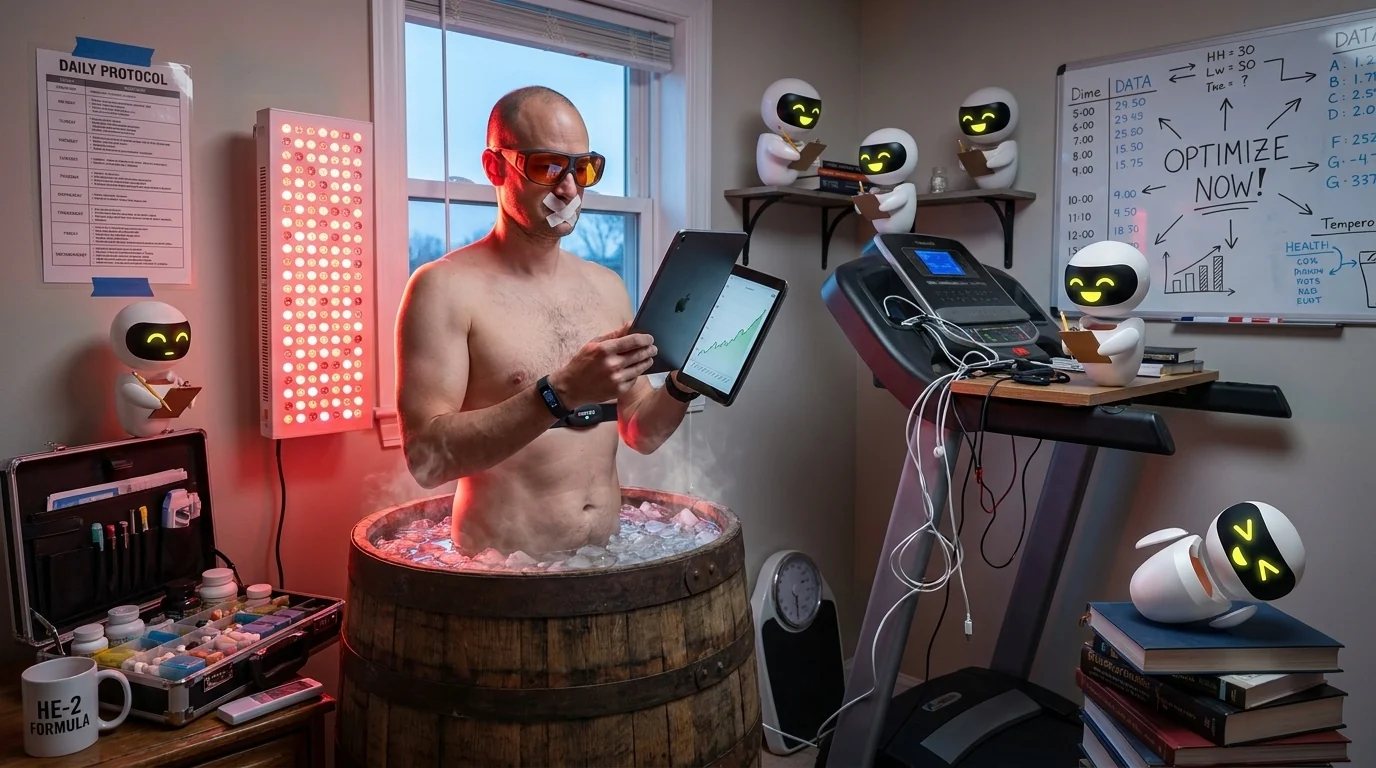
HE-2 has spent the month conducting the experiment in its purest form, and the photograph is not a joke at his expense. There is a barrel of ice. There is a supplement case sorted by hour, a protocol laminated to the wall, a sleep score announced before good morning, and a recovery regimen for the regimens. He can tell you every number. He cannot yet tell me what he is training for. The Chippus have been taking notes, and several of them are laughing, and I have not asked them to stop, because the man in the barrel is doing in public what most of the audience is doing privately with a phone.
Optimisation is the mathematics of a τέλος you already hold. It has nothing whatever to say about which τέλος to hold, and it will never once interrupt you to ask. That silence is not a defect in the method. It is the method, working exactly as designed.
So read King. Then set the phone face down — a small ritual, badly optimised, costing you nothing you were using — and put the question to yourself in your own voice, with no one keeping score.
Quorsum haec omnia?
To what end, all of this?