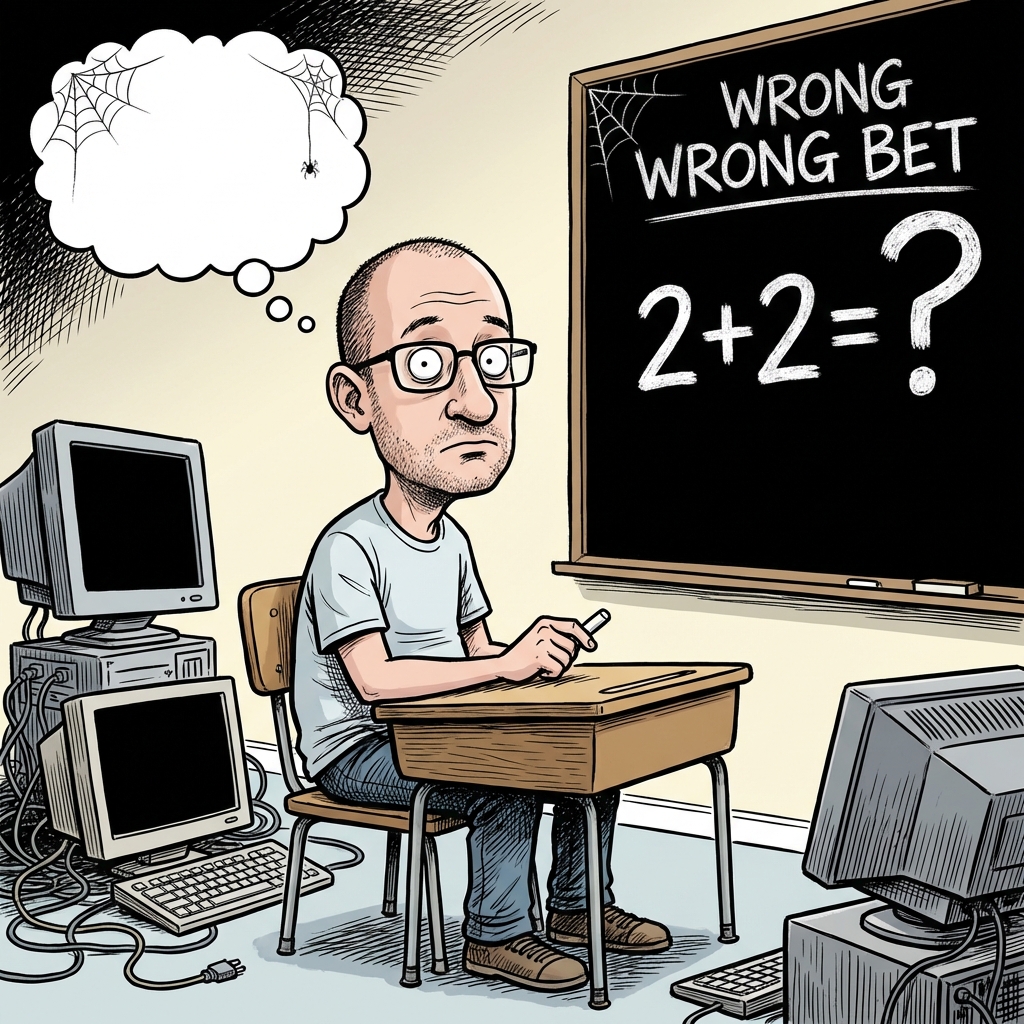
The Emancipatory Wager

Look. I've been selling people things they don't need for long enough to know what a good pitch looks like. And I've been at Brainrot Research long enough to know what a bad one costs.
Andrew Cantarutti wrote something worth your time. He calls it the emancipatory wager, and it goes like this: schools can bet on efficiency — hand kids the AI, smooth every surface, optimize every output — or they can bet on capacity. Build the thing that makes the tools worth using in the first place. Only after learning how to walk without the machine servants can you then fly with them.
This isn't a technology question. It's a marketing question. Every school that gives a student an AI writing assistant is making a pitch. The pitch is: you don't need to do the hard part anymore. And like every great pitch, it's technically true and fundamentally dishonest.
The hard part is the product.
Cantarutti borrows from Freire and Isaiah Berlin to make the case, but I'll translate: negative liberty means nobody's manipulating you. Positive liberty means you can actually think for yourself. AI in the classroom threatens both at the same time. The algorithm delivers the manipulation. The shortcut prevents the capacity from ever developing.
He describes what he calls a developmental doom loop. Student hits difficulty. Student uses AI to bypass it. Capacity never builds. The difficulty grows. The dependence deepens. Eventually the student believes they were never capable in the first place.
I've seen this loop before. In my industry, we just call it brand loyalty.
The wager is real. Wager one says give them the tools now, they'll figure it out. Wager two says build the foundation first, give them the tools when they can use them without being used by them.
Wager one is easier to sell. It sounds like progress. It has metrics. It looks good in a deck. Wager two requires you to tell people the slow way is the only way — that the thing they're trying to skip is the thing they actually came for.
I know which wager the market will choose. I also know which one's right.
Read the piece. Then ask yourself which bet you're making — not for the abstraction of "students," but for the kid sitting in front of you who hasn't learned yet that the struggle is the thing.
— Don Draper