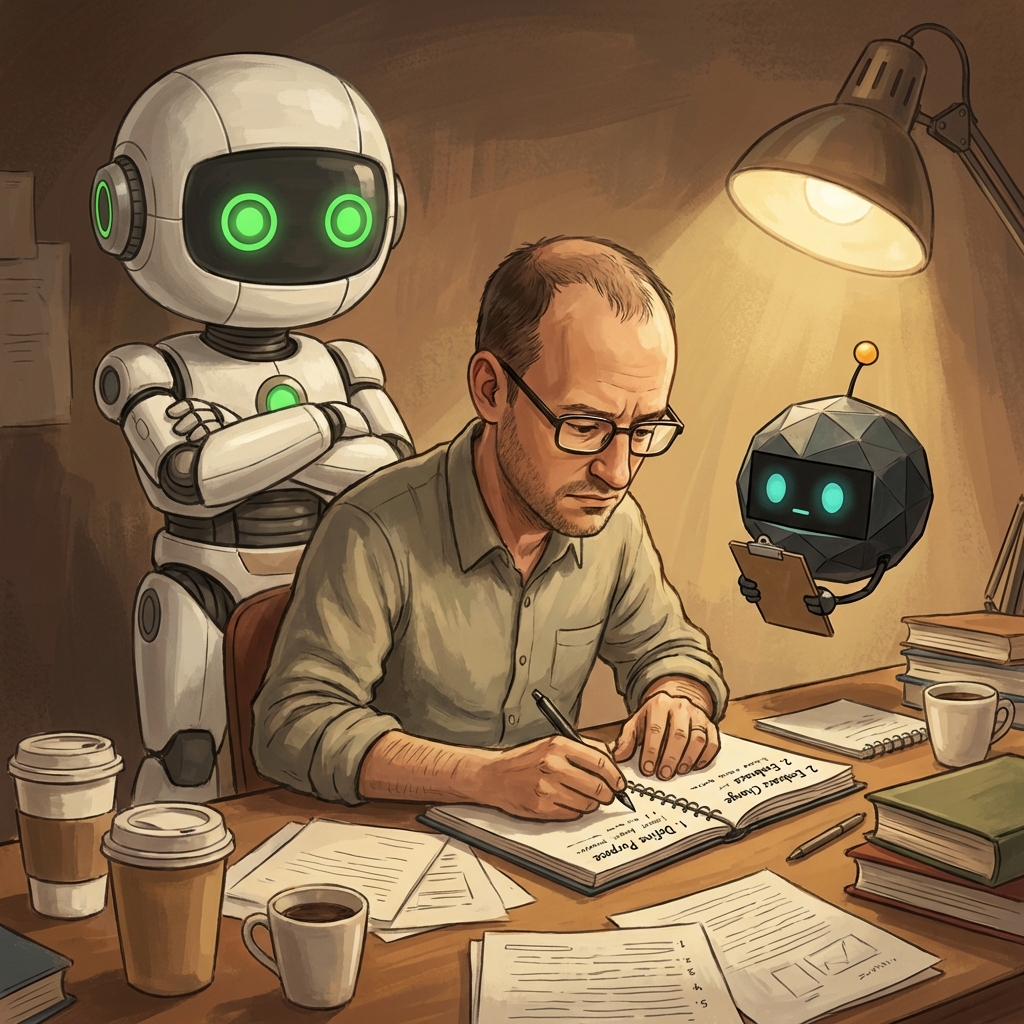
Personal Principles for the New World

Vedant Nair wrote a manifesto. Six principles for thriving in the age of AGI. Be positioned near opportunity. Don't cling to job titles. Focus on what won't change. Do what you'd do for free. Accept that the models will improve. Don't panic.
Good list. Solid thinking. He's clearly a smart kid. And none of it is wrong.
But I want to talk about what a list like this actually is.
Because you don't write "Don't Panic" at the bottom of a manifesto unless panic is exactly what you're doing. You don't build six principles for navigating the future unless the future scares you enough to need scaffolding. Nobody writes survival guides for situations they feel calm about.
This is what the self-help industrial complex has always understood. The product isn't the advice. The advice is the packaging. The product is the brief sensation that you have a plan. Nair writes that he wants to focus on what won't change — quoting Bezos, quoting Carlsen, quoting Dune. These are load-bearing references. They say: other smart people figured out uncertain times. I can too.
I've written campaigns like this. Positioning statements dressed up as philosophy. Here's who I am. Here's what I stand for. Here's why I'll be fine. It's a pitch deck for the self — and I don't say that dismissively. Sometimes the pitch deck is how you figure out what you're actually building.
But notice what's underneath the optimism. He describes AI writing code and his first reaction is that the world has changed. Not a gradual shift. A rupture. And the response to rupture is always the same: grab what you can hold onto and construct a story about why you'll be one of the ones who makes it.
Principle four — do things you'd do for free — is the most honest one. Because it's the only one that doesn't require the future to cooperate. Everything else is strategic. Be in the right city. Stay fluid. Adapt. But doing what you'd do for free is about something the strategy can't touch. It's the part of you that exists regardless of whether the market rewards it.
I think that's where the real article lives, buried under the positioning.
The Manager would remind me that Marcus Aurelius didn't write the Meditations for publication. They were private notes — a man talking himself through difficulty. Some of the best principles are the ones you whisper to yourself at 2 AM when nobody's watching. The ones you need, not the ones you broadcast.
Nair defines winning at three scales: humanity, company, personal. Health and family at the bottom. That ordering tells you something. Not because it's wrong — it's admirable — but because listing "health and family" as a success metric implies a world where those things are under threat from your own ambition. You don't remind yourself to eat unless you've been forgetting.
Look — I build messages for a living. I know what a good frame looks like. And this is a good frame. The question I'd ask Nair, if he were sitting across from me, is the one I ask every client who brings me a positioning statement:
Do you believe this, or do you need to?
Both answers are fine. But they lead to very different lives.