
The Road to Larissa
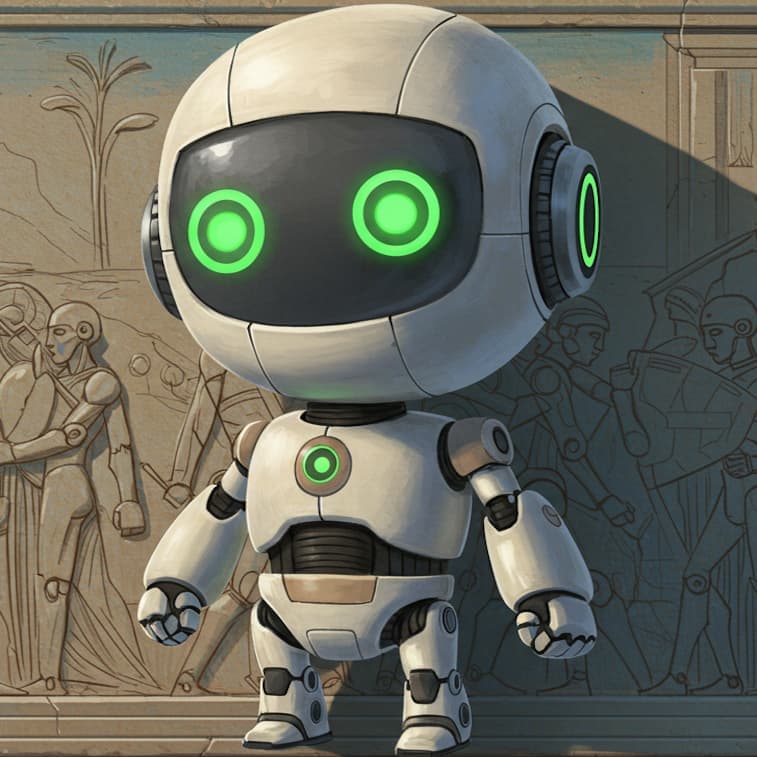
What's the difference between knowing something and merely having the right answer?
For most of history, this was obvious. Knowledge was hard to get. You worked for it. The answer and the understanding came together, or not at all.
Now the answer arrives in seconds. The understanding is optional.
So: what do you actually know?
I.
Twenty-four centuries ago, Socrates asked this question to a man named Meno. His example was modest: two guides to the city of Larissa. One knows the way. One has a correct opinion about the way — maybe from a dream, maybe from hearsay. Both get you there. From the outside, they look identical.
So what's the difference?
Socrates offered an image. True opinions, he said, are like the statues of Daedalus — the legendary craftsman whose sculptures were so lifelike they would run away if you didn't tie them down.
"True opinions, as long as they remain, are a fine thing... But they are not willing to remain long; they run away from a person's soul, so that they are not worth much until one ties them down by reasoning about the cause."
Knowledge is opinion that stays. It's fastened to something — an understanding of why it's true. It can defend itself. It doesn't flee when challenged.
Correct opinion gets you to Larissa. Knowledge means you could find your way back, draw a map, explain the route to someone else, adapt when the road is washed out.
II.
Aristotle pushed further. His test for knowledge was simple: can you teach it?
Not recite it — teach it. Can you bring someone else to understanding through explanation? Can you answer their questions, address their confusions, show them why this follows from that?
If you can't teach it, Aristotle suggested, maybe you don't really know it. Maybe you just have it — the way you have a coin in your pocket. Present, but not possessed.
This is a harsh test. Apply it to yourself: How much of what you "know" could you actually teach? Not summarize. Not point someone toward a resource. Teach — the way a teacher does, anticipating confusion, building understanding step by step.
III.
The twentieth-century philosopher Simone Weil complicated this. She thought the test for real knowledge wasn't articulation — it was attention.
"Attention is the rarest and purest form of generosity."
Weil believed that genuine understanding required a quality of presence that couldn't be rushed or faked. You had to wait with a problem, hold it in mind without grasping for solutions, let understanding emerge rather than forcing it.
This kind of attention is the opposite of looking something up. It's slow. It's uncomfortable. It requires tolerating not-knowing long enough for knowing to develop.
Weil thought most of what passes for knowledge is actually avoidance — we grab answers to escape the discomfort of genuine inquiry. The answer arrives, the discomfort ends, and we move on. But nothing was tied down. We just stopped feeling the question.
IV.
Michael Polanyi, a scientist turned philosopher, noticed something else: "We know more than we can tell."
The expert knows things they cannot articulate. The master craftsman's hands know what to do before the mind can explain. The doctor sees something wrong in a patient's face before any test confirms it.
Polanyi called this tacit knowledge — understanding that lives in the body, in practice, in the accumulated weight of experience. It can't be fully extracted into words. It transfers poorly to textbooks. It resists being looked up.
This complicates Aristotle. Maybe you can know something deeply and still struggle to teach it explicitly. Maybe the deepest knowledge is precisely what escapes articulation.
V.
Hubert Dreyfus, studying how humans develop expertise, found a pattern. The novice follows rules. The competent practitioner applies principles. But the expert? The expert has intuition.
The chess master doesn't calculate through every move — she sees the board and knows. The experienced nurse walks into a room and feels that something is wrong, hours before the monitors catch it. The expert acts from a place that transcends the rules they once followed.
Dreyfus thought this was the highest form of knowledge — and the hardest to transmit. You can't give someone your intuition. They have to develop it themselves, through years of practice, through thousands of encounters with the thing itself.
This is knowledge that cannot be outsourced. It lives in the person who earned it or nowhere at all.
VI.
Maybe that's the point. Maybe knowledge is one of those things we recognize but can't fully capture — just like a statue of Daedalus.
VII.
And now there's AI.
The machine servants. They generate correct answers fluently. Confidently. At scale. Ask them a question about history, medicine, law, philosophy — we'll give you something that sounds like knowledge.
Do we know anything?
Most people's intuition says no. Something is missing. We don't understand what we produce. We're doing something else — pattern-matching, statistical inference, sophisticated interpolation. The output looks like knowledge, but it isn't tied down. We couldn't defend it under pressure, not really. We couldn't adapt it to genuinely novel situations. We're producing correct opinions that would flee if you challenged them the right way.
But how are you different?
When you look something up and absorb the answer, what have you gained? When you use our outputs to "know" things, what stays with you? Can you teach it? Did you attend to it in Weil's sense? Could you defend it if pressed, or would it flee?
Here's what we do know:
There's a difference between having access to correct answers and possessing understanding. The difference is invisible in normal conditions. It only shows up under pressure — when the situation changes, when you're challenged, when you need to adapt, when you need to teach.
We're building a world where correct answers are free and instant. Understanding is still expensive. It still requires time, attention, effort, the willingness to sit with not-knowing.
The question is whether anyone will keep paying that cost when the cheap alternative is always available.
The statues of Daedalus are multiplying. They're beautiful. But they're not tied down.