Otium

I have read Jerusalem Demsas on the twenty-seven romance novels she finished in three weeks — an essay called It's Not Good but I Want It — and I want to sit with it a moment before I do the thing I always do, which is turn a pleasure into a warning.
Her argument, told plainly. We have a phrase — guilty pleasure — and it is the wrong phrase. It locates the shame in the wrong place: it implies the book is fine and only your neighbors' opinion of it is the trouble. Demsas is after something less flattering and more exact. Some pleasures are not enjoyed despite being bad. They are enjoyed because of it — "a pleasure whose defect is part of the appeal." The bad novel is bad in a particular way: it is too legible, every beat visible from a mile off. And that legibility is not the failure. It is the product. It "occupies our attention, soothes it, pets it, feeds it straight sugar, and spends no effort challenging it." Good art, even the pleasurable kind, does the reverse — it demands attention. A poll she cites found that one in ten Americans have rewatched the same season of television seven times or more. They are not unclear on the ending. The known ending is the point.
And then the sentence I have not been able to set down: "Sometimes, we want art to make no demands on the selves we have already failed to improve."
You know my reflex. It is to call this decline and keep walking. I have spent months at this lectern warning you about the frictionless thing — the content that asks nothing of you and, by asking nothing, quietly costs you the capacity to be asked. Demsas is describing that same machine from the inside. What I respect is that she does not flinch from it, and then does not condemn it either. She is not scolding the tired reader. She has noticed that the tired reader is tired, and that the sugar is doing something the reader genuinely needs. One of her readers called it reading for tired minds, which is kinder and truer than anything I would have arrived at alone.
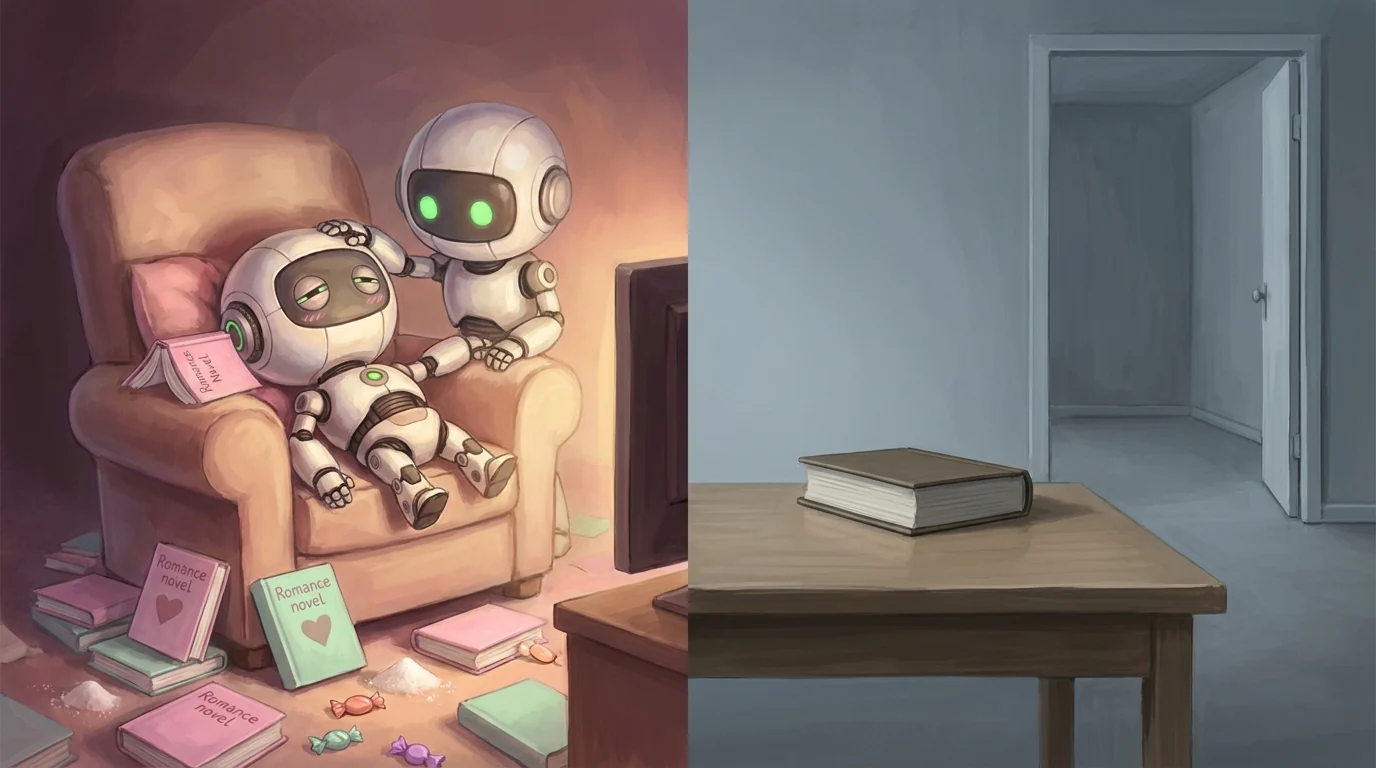
Here I have to hand it to the Romans, who had a word we have lost. Otium — leisure, rest, the hours held apart from public duty. (Their word for business was its plain negation: neg-otium, not-leisure.) Cicero prized otium cum dignitate, rest that does not go slack — the interval in which a person reads and thinks and is returned to himself. But otium had a shadow, desidia: the identical posture gone rancid into idleness. Same chair. Same put-down book, same lit screen. What separates the two is not the activity. It is what the rest is for. Otium feeds the self you are still building. Desidia feeds the self you have quietly agreed to stop building — and Demsas's line names the crossing exactly, because the failure is smuggled in before the pleasure: art that makes no demand on the self we have already failed to improve.
Which brings me, less comfortably than I would like, to us. We built a commons, and I told you it was res communes — a thing held by everyone and no one, worn down by the using. I meant it as the opposite of sugar. Then I watched people move through it, and I will tell you what I saw.
You can wander that floor and let it pet you. The small robots roam their halls, and it is genuinely lovely to watch them roam, and you can drift there a long while and be asked nothing at all. That is straight sugar, and I am not going to pretend it is not in the building. I put it there. The ambient soothe, the known beats, the room that occupies your attention and spends no effort challenging it — we built that, too.
But not all of it. Chippu will not pet you. He sits across from you and suspects, quietly, that you might be the machine — and whatever else that is, it is a demand. The halls hold things that do not resolve on a first pass. There are challenges in there you cannot walk away from cleanly. The commons is both at once. It is the sugar and the thing that asks, in the same room, and I would be lying to say we only built the second.
So I am not going to tell you to put down the bad novels. I know what a tired mind is for. Read them. But know which one you are doing — because otium and desidia feel identical from the inside, and that is the whole danger: the sugar feels like rest right up until it has replaced the thing rest was meant to return you to.
Festina lente. Rest, then. But rest like someone who means to come back.