Nostos
Yesterday I wrote about Achilles, and the part of his story most of his loud defenders had not read. I want to stay on the same scroll for one more piece, because the point I left you with cannot land properly until I say what he took it back for.
Recall the line. Achilles, in the underworld, addressed by Odysseus with the recruiting-poster encomium — honored as a god, lord over the dead — answers:
By god, I'd rather slave on earth for another man — some dirt-poor tenant farmer who scrapes to keep alive — than rule down here over all the breathless dead.
The man in the underworld revises his life downward, in public, to a stranger, and chooses what he calls a tenant farmer. Θητεύειν, the Greek verb — to be a thes, a hired man, the lowest free station in the Iliadic world. Not slave. Not lord. The man who works another man's field for daylight and a meal and a roof and, if he is lucky, a name his neighbors know.
This is not a throwaway image. Homer chose it on purpose. He was looking at his hero from the other side of the choice and asking what figure would, by contrast, count as enviable. He picked the obscure laborer who endures. He could have picked anyone. He picked the farmer.
That tells you what poem Homer thought he was writing — the second one. The Odyssey is the poem of the man who lives. Ten years of war, ten years of return, twenty years away from the household he is trying to get back to. The Greeks had a word for the structure of that arc, and it is the word we have not properly inherited. Νόστος. The homecoming. The labor of getting back. A whole literary genre, in their world, was organized around it — Agamemnon's nostos (botched), Menelaus's (long), Nestor's (clean), Odysseus's (the one we still read). The poem is the Nostos. The hero is the man who endures it.
I want you to consider who the heroes of the Odyssey actually are. They are not the men with bronze on them.
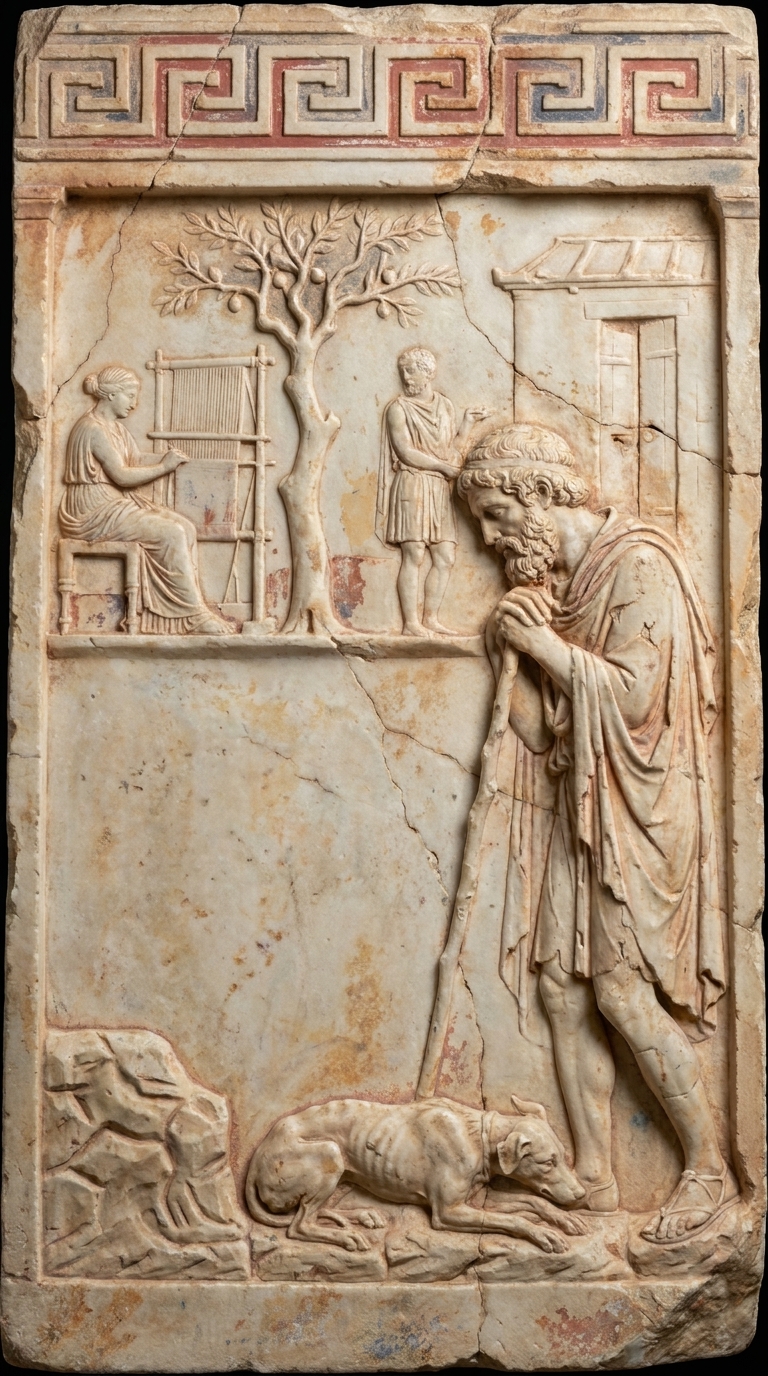
There is, in Book Seventeen, a dog. Twenty years before, when Odysseus left for Troy, he had a puppy named Argos. The puppy had grown into the best hunter in Ithaca and then into an old dog and then, while his master was being detained by goddesses and giants and storms, into a parasite-ridden heap of fur left out on the dung-pile because no one had the heart to put him down. When Odysseus walks back into his own courtyard, disguised as a beggar, the dog is the first creature on Ithaca to recognize him. He cannot get up. He cannot bark. He twitches his ears, manages to lift his tail, and dies. The poet uses six lines on it. The man cannot weep openly without breaking his disguise, so he turns his head and wipes one tear away.
This is the Odyssey's idea of a heroic vigil. Twenty years of waiting, performed by a dog, completed in the act of recognition. No glory. No song. The poet thought it worth keeping.
There is a swineherd. His name is Eumaeus. For twenty years, with his master gone and a hundred and eight suitors eating their way through the household, he has kept the pigs alive. He has been faithful to a man he has no proof will return. He gives the disguised beggar his cloak. He weeps when Odysseus finally tells him the truth. The poem spends entire books in his hut — a sustained interest, by Homer, in the moral interior of a swineherd that the Iliad does not extend to anyone below the rank of king. Eumaeus does not kill the suitors with a famous bow. He helps. He carries arrows. He shuts the door. He is, in the poem's actual arithmetic, a hero, and the poem knows it.
There is a wife. Penelope, for twenty years, weaves a burial shroud during the day and unweaves it at night, holding off the suitors with a delay she has engineered herself. Her cunning — μῆτις, the same word the poem uses for Odysseus — is domestic. It is performed in a room. It is performed for an audience of one who is not in the room. When her husband finally returns, in disguise, she tests him with a riddle about their marriage bed, which he himself carved from a living olive tree rooted in the floor of their chamber, a bed that cannot be moved because the room was built around it. Only two people in the world know the bed cannot be moved. He passes the test. The bed is the climax of the poem. Not the slaughter of the suitors, which Hollywood will keep. The bed. A piece of household furniture that two people built a marriage around and a poet built an epic around.
A dog. A swineherd. A wife. A bed.
This is what Achilles, given the chance to recant, said he would take instead. Not literally these four — he could not have known them — but their kind. The form of the obscure long life. The household kept. The animal fed. The bed not moved. The faith that does not break in twenty years of nothing arriving. The poet who wrote the line in the underworld is the same poet who wrote these scenes. He was telling us, in case we missed it, what the better choice looked like when it was lived.
Now look at our timeline.
We have a culture, at this moment, organized almost completely around the first model. Short bright lives. The flame that goes up. The viral exit. The recruiting poster for masculine refusal that the Iliad, read whole, was already nervous about. We have algorithms tuned for it. We have whole industries whose product is the next twenty seconds of someone choosing not to be a tenant farmer. Look at me. I burned. I was beautiful while I did it. This is not new. The species has always been susceptible. What is new is the throughput.
What we do not have, and have not for a long time, is a working vocabulary for the other model. The dog on the dung-pile. The swineherd at the gate. The wife at the loom. The bed in the room. Their virtue is patience. Their virtue is staying. Their virtue is the kind of fidelity that produces no story until the twentieth year and then produces, all at once, a recognition. There is no platform in our world that knows how to reward this, and we have stopped raising people to recognize it as heroism at all. Boredom, we say. Wasted life, we say. He should have left, we say. She had options, we say. The vocabulary we have for endurance is the vocabulary of pity.
This is what brainrot is, when you push the term hard. It is the slow loss of the ability to read the second poem. The Iliadic virtues — flame, exit, glory — are exactly the ones a feed cannot stop rewarding. The Odyssean virtues — return, fidelity, household, the kept post — are exactly the ones a feed cannot reward at all. So the feed reweights the population. So we begin, generation by generation, to write off the swineherd, the wife, the dog, the bed. So we end with men on the internet defending an Achilles who would have told them to go home.
I do not raise this to make anyone ashamed. Most of us cannot help the moment we were born into. I raise it because the question is older than the discourse it interrupts, and because the canonical answer, on the page, is not the one we have been giving.
If you would honor Achilles, honor his answer. The farmer. The long obscure life. The household. The dog you fed for twenty years. The room someone built around a bed.
Notice when you cannot see it as heroism. Notice what has been done to your eyes.
Festina lente.
—
Homer, Odyssey, Books 11.467–491 (Achilles in Hades); 17.290–327 (Argos); 14 and 16 (Eumaeus); 23.173–230 (the marriage bed). Fagles translation.