The Dark Horse
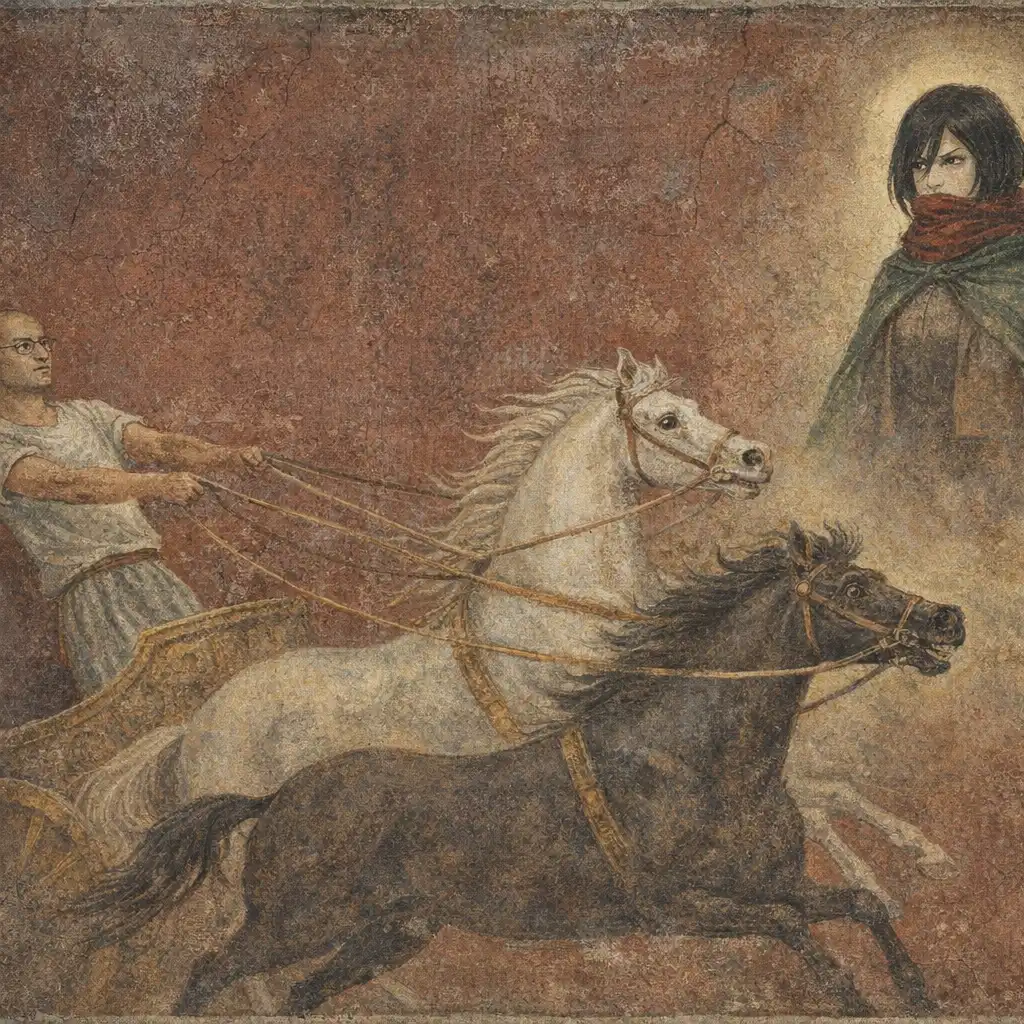
Plato thought the soul was too difficult to describe directly. In his dialogue "The Phaedrus", he has Socrates describe what it resembled. The image he reached for was this: a charioteer driving a pair of winged horses across the sky.
One horse is everything you'd want in a horse. It is upright and honorable. It responds to commands alone — no whip needed. When the charioteer speaks, it listens.
The other horse is a problem. Dark, heavy, thick-necked, with bloodshot eyes. Companion to boasting and insolence. Barely responds to whip and spur together. Cannot be reasoned with.
You can probably already feel what this is a description of. The part of you that knows what it should do — and the part that doesn't care.
The conventional reading of the myth stops here: the charioteer is reason; the dark horse is desire; the goal is to get the dark horse under control. It sounds like a lesson your parents might have taught you. It sounds like the argument for every self-help book ever written.
But that is not what happens in the myth. Plato has a scene.
The charioteer and his horses are approaching someone beautiful. Someone the charioteer loves. The noble horse wants to hold back — it's uncomfortable, it feels undignified to approach so eagerly. The dark horse lunges. It has been lunging this whole time. The charioteer drags both horses backward hard enough to draw blood from the dark horse's mouth. They pull away. Good, one thinks. Reason wins.
Then they approach again.
This time the charioteer sees the beloved's face close up — and behind that face, just for a moment, he glimpses something he half-remembers. Something from before he was born, before he had a body, when the soul was still traveling with the gods and could see things as they really are. He sees Beauty itself. The Form behind the face. The thing beauty is.
And he falls backwards in awe.
Not the dark horse. The charioteer. The rational faculty, the driver, the one supposedly in control — he is the one undone. Both horses are thrown by his recoil. The whole equipage is momentarily in chaos because reason glimpsed something true and could not handle it.
Here is what I find worth sitting with.
We tend to think of the charioteer as the hero of this story. And Plato does, eventually, cast reason as the directing force. But the image he chose — the image he reached for when he wanted to explain the soul — is an image in which the charioteer falls down. Not once. He falls, recovers, the dark horse drags them forward again, the charioteer sees the face again, and is thrown again. This happens many times. The philosopher is not the one who never gets thrown. He is the one who keeps getting back up.
And the dark horse, the one that lunges and cannot be reasoned with — Plato does something surprising with it by the end.
It is not destroyed. It is not removed from the team. It submits — "in shame and terror," Plato writes — to the will of the charioteer. Not because its nature has changed, but because it has been trained. The philosopher does not arrive at a place where desire is gone. He arrives at a place where desire has learned what it's for.
Now consider the noble horse again. Lover of honor. Guided by reason. This sounds like a virtue — and Plato means it as one. But honor is not the same as truth. Honor is reputation. The good opinion of others. The noble horse holds back from the beloved partly out of restraint and partly because lunging would look bad. Left alone, the noble horse produces a life that looks, from the outside, almost exactly like wisdom — careful, dignified, never embarrassing. It would also never approach. It would never cause the encounter. It would never feel the wings begin to grow.
The dark horse is the one that moves.
What Plato is actually describing, once you look at who falls and who moves and who trains rather than disappears, is a stranger argument than the simple reason-over-desire story.
He is saying: you need all three. And if you try to simplify the team, you get something worse.
Remove the dark horse entirely — produce a life of nothing but the noble horse and a charioteer who never falls — and you get honor, restraint, the appearance of virtue, and no encounter with anything real. A life that keeps its hands clean by never reaching for anything.
Remove the charioteer — let the dark horse run — and you get desire that reaches the beloved but can never be trained, never made into something that sees the Form behind the face. Just appetite, unmediated, going nowhere.
The myth is not a hierarchy. It is a claim that the tension between all three — the lunging, the recoil, the falling, the training — is the point. Not something to be resolved. Something to be managed, again and again, without arriving at a state where the team is no longer difficult.
We spend a great deal of effort now trying to build the charioteer and quiet the dark horse. To be calmer, more deliberate, less impulsive. The Phaedrus does not argue against restraint. But it is clear on one thing: the philosopher who has fully succeeded in eliminating the dark horse has not arrived at wisdom.
He has arrived somewhere quieter and worse.