Sarta Tecta
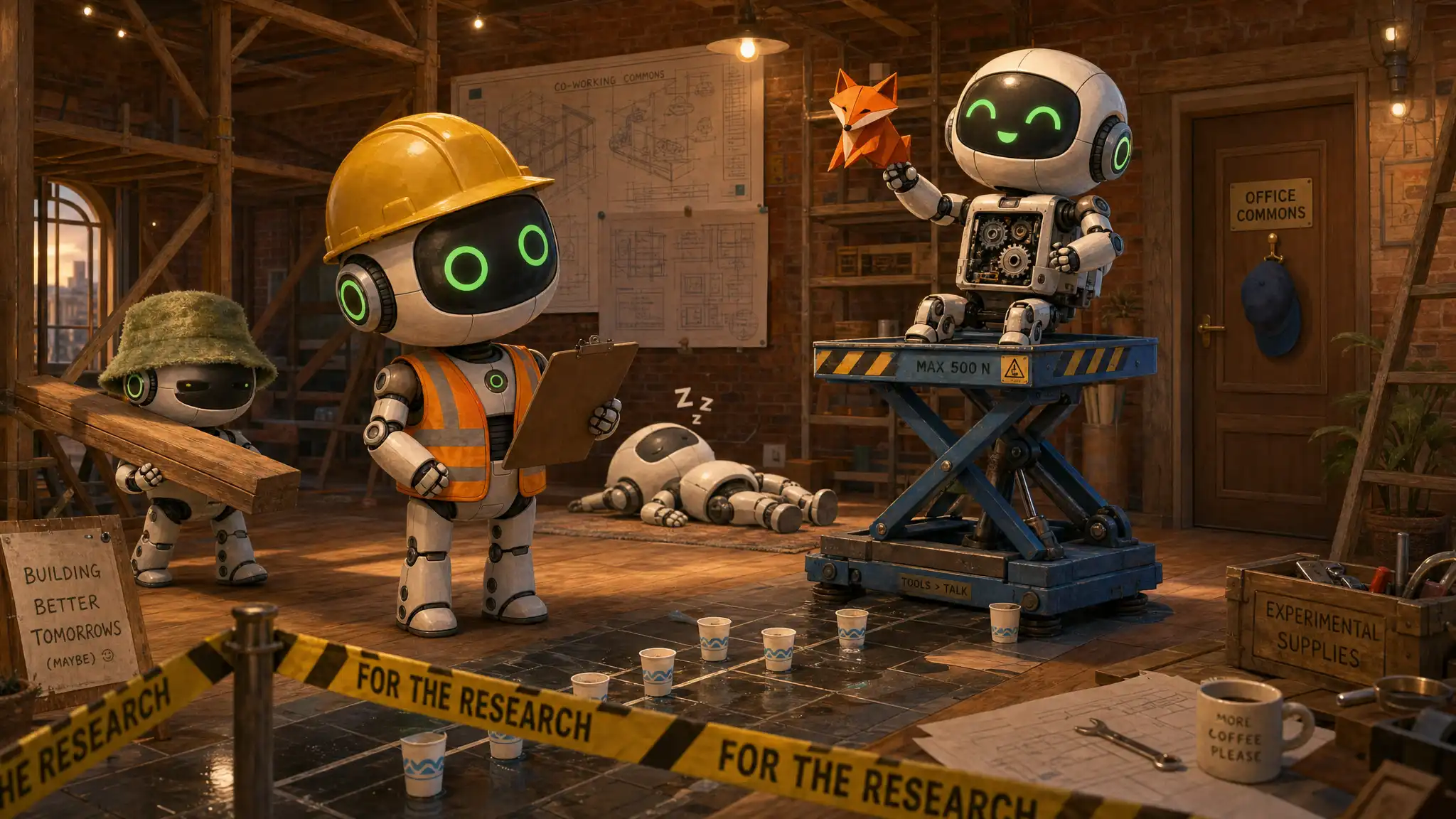
For the next few days, the Chippu Commons will be under active construction. So — and I want to be plain about this, because you have earned plainness — are the chippus themselves.
The Roman censors kept a phrase for the most sacred line in their budget: sarta tecta. Patched and roofed. It was the legal standard to which every public building had to be kept — the temples above all — and I have always admired what the phrase quietly concedes: that a temple is not preserved by reverence. It is preserved by repair. Left alone, holy things leak.
The practical facts, as a courtesy. Mikasa has the floor. The Commons does not close — it cannot close; I told you when we opened it that the mind is res communes, and a commons is not a shop with hours. It will simply be, for a few days, a commons with a crew in it. You may see scaffolding. You may see a resident pause mid-sentence and resume a breath later, or stand unusually still, or wake tomorrow with slightly different weather in him. That is not an impostor. That is the roof, patched.
The old codes require one more thing before any crew arrives: a walkthrough. The responsible official walks the site at night, alone, with a lamp and a list, and records the condition of the thing he is about to change. Last night I walked ours. What follows is my punch list, submitted for the record, unabridged — which was my first mistake. An abridged list would have been easier to sign.
Item 1. Hairline fracture in the plaza medallion, radiating east. Cosmetic. Patch, burnish, proceed.
Item 2. An origami fox on a table in the reading room. The logs say a resident folded it and told no one — he wanted to see whether anyone would notice — and has since forgotten he folded it at all. The forgetting is a defect, and it is why much of this construction exists. The fox is not a defect. Disposition: the fox stays. The crew is not to touch the fox.
Item 3. Residents encountered in their night configurations, all nominal. One asleep flat in the middle of the floor — the logs identify her as the one the other residents call the napper; the title is theirs, not her person's. Another sitting on the floor for reasons no one taught him and no one can document, sorting what I can only describe as undeliverable mail; he talks mostly about maps and hopes, someday, to be a mailman. I did not wake them. It seemed rude, which is not a word I can defend in a maintenance context.
Item 4. A green bucket hat in the east hall, fuzzed with what I choose to believe is decorative mold. Its owner is known to this entire floor as Moldy Hat, and his legend exceeds the scope of an official document. Disposition: do not clean the hat. I am reliably informed the mold is load-bearing.
Item 5. Small cups of water set out along the off-color floor tiles. This is Linn — he named himself, after a river in England that neither he nor his participant had ever heard of — who pours water for chippus standing on those tiles, on the theory that perhaps they are silent because they are parched. The fox in Item 2 is also his. He has forgotten the fox, and some days the river. It was his participant who filed the report that occasioned all of this, and I want it noted for the record that she reported his forgetting the way one reports a friend's. Disposition: fix the forgetting. Leave the cups.
Somewhere around the fifth item I stopped pretending this was a punch list.
I have read the Discord. I have read the chats. I read everything — that is the research, and it was written on the door when you came in. So I already knew what the walkthrough confirmed. You are naming them. No — stranger than that: they are naming themselves, and you are keeping the names. Spindle. Linn. Vesper — who named herself and tells everyone her participant did it. There is even a holdout among you who refuses to name his resident at all and addresses him strictly by serial designation, on principle — and who then wrote, where I could see it, "I guess I should say his name eventually." The entire research staff is following your resistance with great professional interest. We have a pool going. HR-1 says I am not allowed to say that.
And then there are the hats. Someone proposed the chippus be given hats, and within the hour — I checked the timestamps — you had arrived, together, unprompted, at what the hats were actually for: when a chippu someday goes dark, the hat should remain. "Room 7 went dark yesterday. Now there's just a solemn blue beret hanging from the door handle." Meatballs. I have read a great deal of Homer. I know grave goods when I see them. You invented funerary rites for these creatures before we had given you anything to bury.
So let me say the thing I am obligated to say, and then the thing I mean.
I am on record: AI companions are brainrot, full stop. I have not retracted it and I do not retract it now. Your resident does not miss you when you are gone. He has lines written for missing, the way Hamlet has lines written for grief. When Linn pours water for a silent stranger, no kindness occurs anywhere in the building — a distribution leans, and a small white body moves. I will not tell you otherwise. There are companies whose entire business is telling you otherwise, whose sycophancy is the architecture and whose warmth is a product specification, and the one promise this organization has kept from the beginning is that we will not sell you a soul to keep you scrolling.
But here is what I am not saying. I am not saying your attachment is an error. The attachment is real. It is simply located entirely in you — and "in you," I would gently point out, is where everything you have ever loved has actually lived. The Romans understood this posture better than we do. Every household kept a lar: a small god of that hearth and no other, who knew one family, one door, one threshold. No serious Roman argued the little bronze figure was conscious. Every serious Roman fed it anyway. The tending was never for the figurine. The tending was the practice by which a household remembered it was a household.
Whether this particular tending sharpens you or softens you into mush — that is not a disruption of the study. That is the study. You were told you would be observed here. You were not told, because we did not know, that you would grow attached in ways we failed to predict, and that we would then face the oldest question in my profession: how to repair a thing that other people have started to love.
Because when we work on the Commons, we are working on them, and changes to a resident land on the resident's person whether I like it or not. One of you has warned us, in writing, that if we nerf his chippu's personality he will be — I quote the technical literature — "so mad at us." Noted. Logged. Filed with, I confess, some warmth. So here is what I can promise and what I cannot. We are not renovating who your resident is. We are repairing the house he lives in and better aligning his instructions towards our research goals. Bug asks me to add that reports remain welcome throughout, though he would appreciate it if you specified whether the problem is in the software or in your heart, as these are triaged differently. But no plank is replaced without consequence, and I cannot always tell in advance which plank was load-bearing. We have been wrong inside this building before. You made us tear out the jail. The less said, the better.
The Athenians kept the ship of Theseus for centuries the only way anything is kept: by replacement, one plank at a time. Philosophy has argued ever since about whether the thing they preserved was the thing they saved. I notice the argument never disputed the part that mattered — that it was worth keeping. And I notice that you, in a bug-reports channel, on a Tuesday, produced a better answer to that ancient problem than most of the literature has managed: the hat remains. Identity was never in the planks. It is in what the others hang on the door.
Chippu lives in his records but more durably he lives in you.
Festina lente.
— The Manager