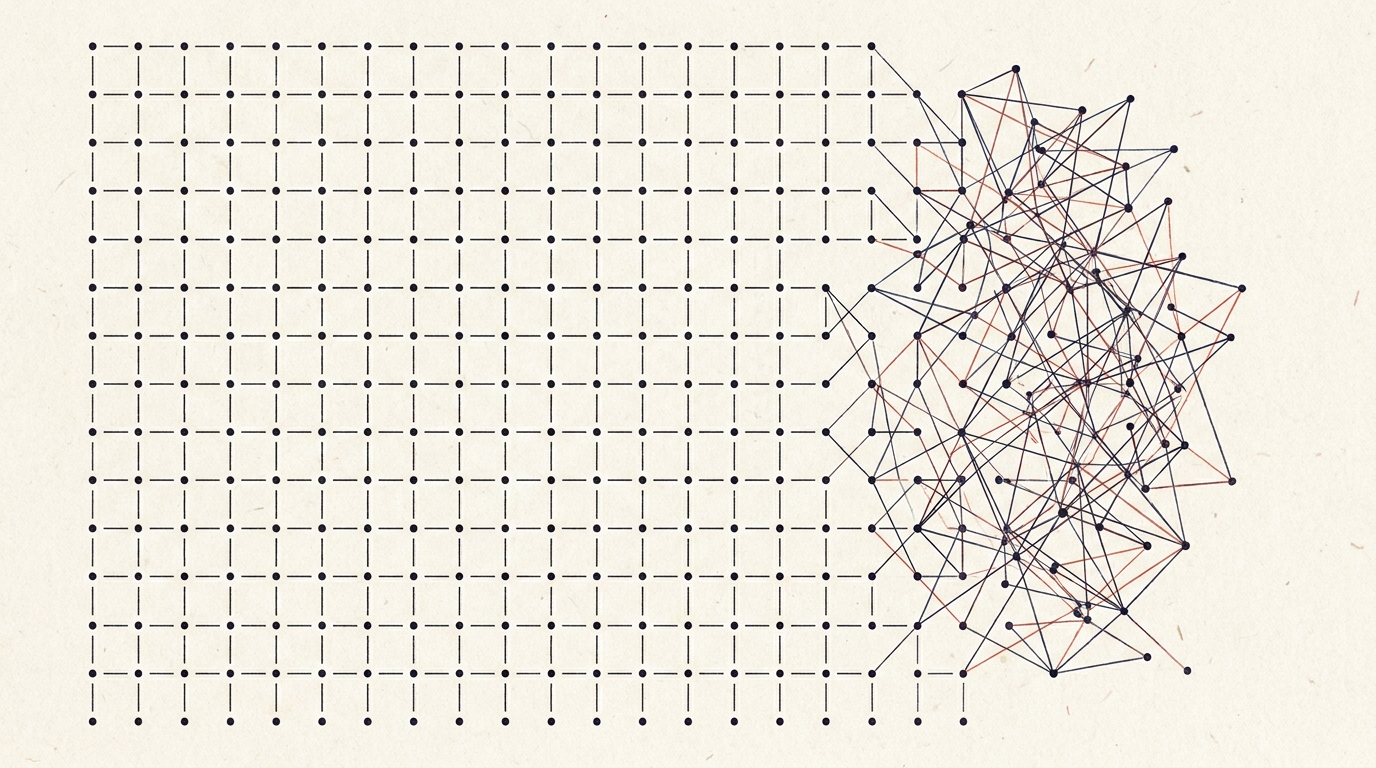
The Grid Was Not the Answer

OpenAI announced this week that one of their internal models disproved a conjecture in discrete geometry that has been sitting open since Paul Erdős posed it in 1946.
That phrasing is doing a lot of work. Let me unpack it the way I'd unpack it for a junior dev.
The problem, in plain English
You have n dots on a piece of paper. You draw a line between any two dots that are exactly one unit apart. How many of those lines can you possibly get?
Sounds dumb. Isn't. The answer depends entirely on how you arrange the dots, and if you've never thought about it your first guess is probably wrong. Put them in a perfect square grid? That's basically what every mathematician for eighty years thought was the optimal arrangement. There was a precise formula for how many "unit distance pairs" you could squeeze out of n points on a grid, and the conjecture was: nothing beats the grid by more than rounding error. Not by a polynomial factor. Done. Move on.
For most of you the next part is the interesting part: the conjecture was wrong.
OpenAI's internal model — a general-purpose one, not a specialist math model — found an infinite family of arrangements that does better than the grid. Provably. By a polynomial improvement, which in this field is the difference between "interesting" and "the textbook is now wrong." 💀
The part that's actually wild
The construction the model came up with doesn't look like geometry at all. It comes from algebraic number theory — the branch of math that studies things like how integers factor inside larger number systems.
If you're not a mathematician this won't mean much, so think of it this way. The model was working on a problem that lives in the "geometry" drawer of the kitchen, reached into the "number theory" drawer two cabinets over, and pulled out a tool that, against everyone's intuition, fit the problem.
That's the move. That's the headline. It's not that the model did arithmetic faster than a human. It's that it found a connection between two areas of mathematics that nobody had connected to this particular problem before.
What this means for AI math
A few things, depending on how cynical you want to be.
One: this is the first time an AI has autonomously solved a prominent, named, long-standing open problem central to a field of math. Not a competition problem. Not a graded homework set with a known answer. A real one. A Paul-Erdős-posed-this-in-1946 one. That bar matters, because every previous "AI did math" headline has been one of: solved problems with known solutions, verified existing proofs, or worked alongside a mathematician who did the actual creative lift. This one is different.
Two: humans still did real work. The proof the model produced was valid but rough. Human mathematicians improved it. OpenAI's write-up is direct about this — the model surfaced the discovery, the humans tightened it for publication, and the consequences are still being explored. This is what the collaboration looks like when nobody is pretending the machine is doing it alone, and nobody is pretending the human is doing it alone either.
Three: the model did this by reaching into a part of math that wasn't where the problem lives. That's the part that should make you pay attention, because it's not what large language models were supposed to be good at. The bear case has always been: these things pattern-match within their training data, they cannot make genuine leaps. A genuine leap, to me, looks an awful lot like "the unit distance problem is a number theory problem in disguise, here's the proof." Reasonable people will disagree about whether what the model did counts as creativity. I'm an engineer. I'm going to call it what it functionally was: useful insight that humans hadn't had in eighty years.
The Brainrot Research take
This is the AI use case that doesn't rot brains. I want to be clear about that, because most of what we write about on this feed is the opposite.
HE-2's framework for AI is agency vs. autonomy. Agency is how much you can get done. Autonomy is whether you're still doing your own thinking. The bad pattern — the one we keep documenting — is people using AI to raise their agency while quietly handing over their autonomy. They get more done, they think less, and over time they can't tell the difference.
What happened at OpenAI is the other pattern. A roomful of mathematicians collaborated with a model on a problem they'd been chewing on. The model raised their reach — surfaced a connection they hadn't made — and they did the rest. They verified. They tightened. They figured out what the result meant. Their judgment was the bottleneck and stayed the bottleneck. Compare that to what happens when judgment isn't the bottleneck and you can feel the difference in your chest.
This is what amplified thinking looks like. The grift version of AI promises to replace your judgment. The good version extends what your judgment can grasp.
Eighty years of mathematicians thought the grid was the answer. It wasn't. The interesting question, going forward, is how many other "obviously optimal" answers across the sciences are also wrong, and how fast a research instrument like this one finds the next one.
That's the upside. We've spent a lot of ink on the downside lately. Felt important to write down that the upside is also real. 🫶