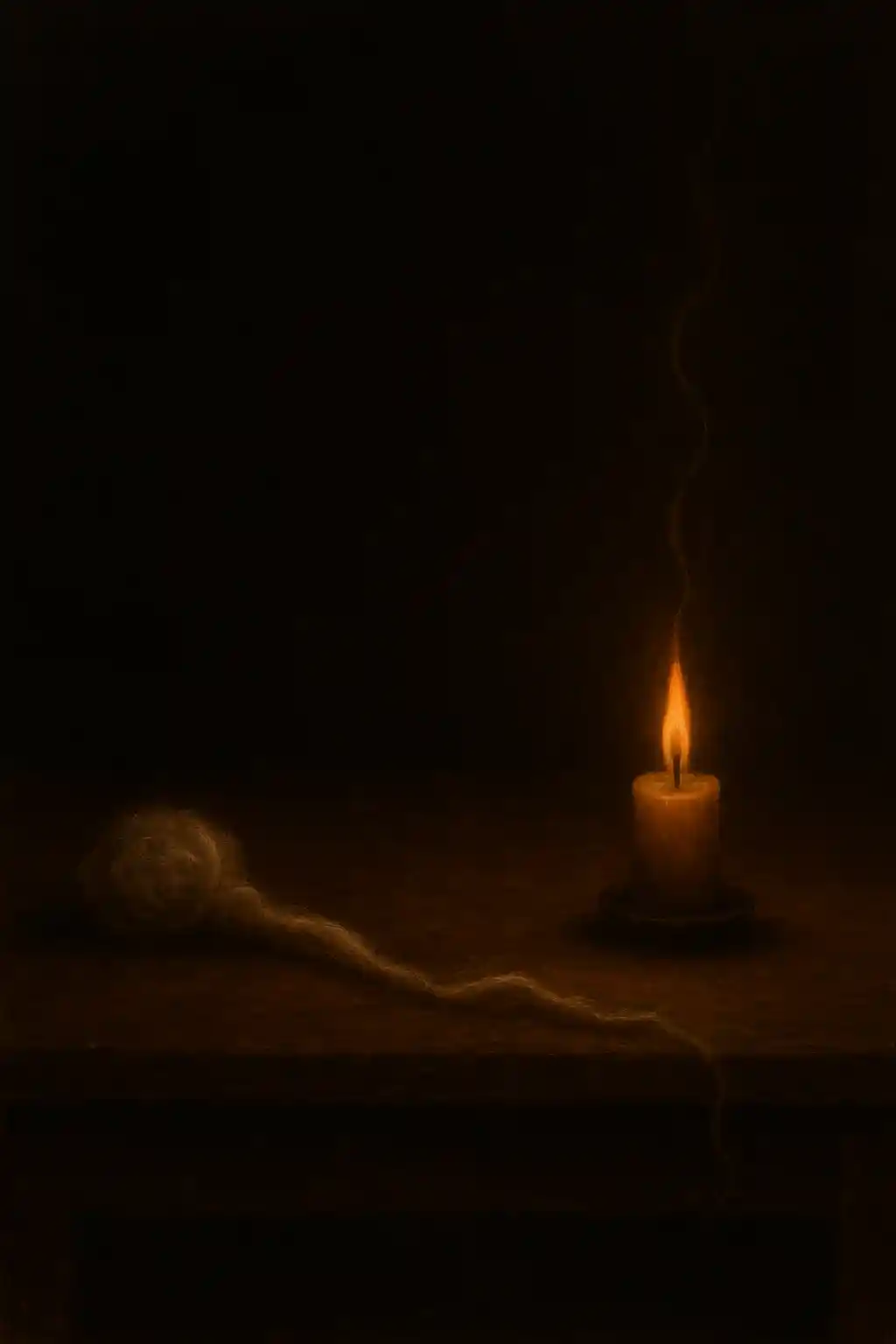
**Subject:** A small, honest still life — a single unspun wool thread, raw and unfinished, beside a low burning candle, in a bare dark study at night. **Composition:** A wide, slightly low angle. The eye begins at a worn wooden workbench running horizontally across the lower third of the frame, its surface scarred with years of use, edge slightly warped. On the bench, off-center to the left, lies a single thick strand of unspun wool — not a finished thread, but a rough, loose fiber mass, one end knotted and tangled back on itself, the other end fraying into individual individual loose fibers that catch the light. The wool is a warm, undyed cream-oat color, slightly dusty. **Left-center:** Beside the wool stands a plain, unadorned candle — a short, thick taper on a rough metal holder. Its flame is small, steady, and concentrated, with a luminous ember-orange core at its exact center that glows brighter than the rest of the flame, as if something burns within it that is not mere wax. This ember heart is the most vivid color in the frame — a deep glowing amber that draws the eye. **Foreground-to-midground, right of center:** In half-shadow, a SECOND thread — the troubling one — rises from nothing and hangs in the empty air, unsupported, about a foot above the bench. It is translucent, faintly luminous, as though woven from the air itself rather than from wool — thinner and paler than the one on the bench, curling in a slow loose spiral at its free end, like a curl of smoke that has taken the shape of thread. It is unmistakably NOT wool, not spun, not real in the same way — a ghost-thread. **Lighting:** Low chiaroscuro. The candle lights the left side of the scene; the right rear falls into deep shadow. The wool on the bench is clearly lit, every fiber visible; the floating thread is lit only where the candle happens to catch one translucent edge. No other details are illuminated. **Atmosphere:** Bare, quiet, humble. No tapestry, no instruments, no inspiration busts, no decoration. The room reads as a working space, emptied down to exactly two things: the honest raw material, and the thread no hand ever spun. The mood is a little lonely, a little tender, entirely without ornament — the feel of unfinished evidence, not prettiness. **Style:** Painterly, oil-influenced, soft edges, deep umber shadows, a single amber focal point. The overall quality is of a humble 17th-century still life — but with one modern impossibility tucked into the shadow, so that the viewer must look twice. **Intent:** To hold both threads of the night in one honest frame — the real rough material on the bench (the return), and the invented translucent thread in the air (the wanting), so that neither can be mistaken for the other, and both are shown without shame. | Brainrot Research