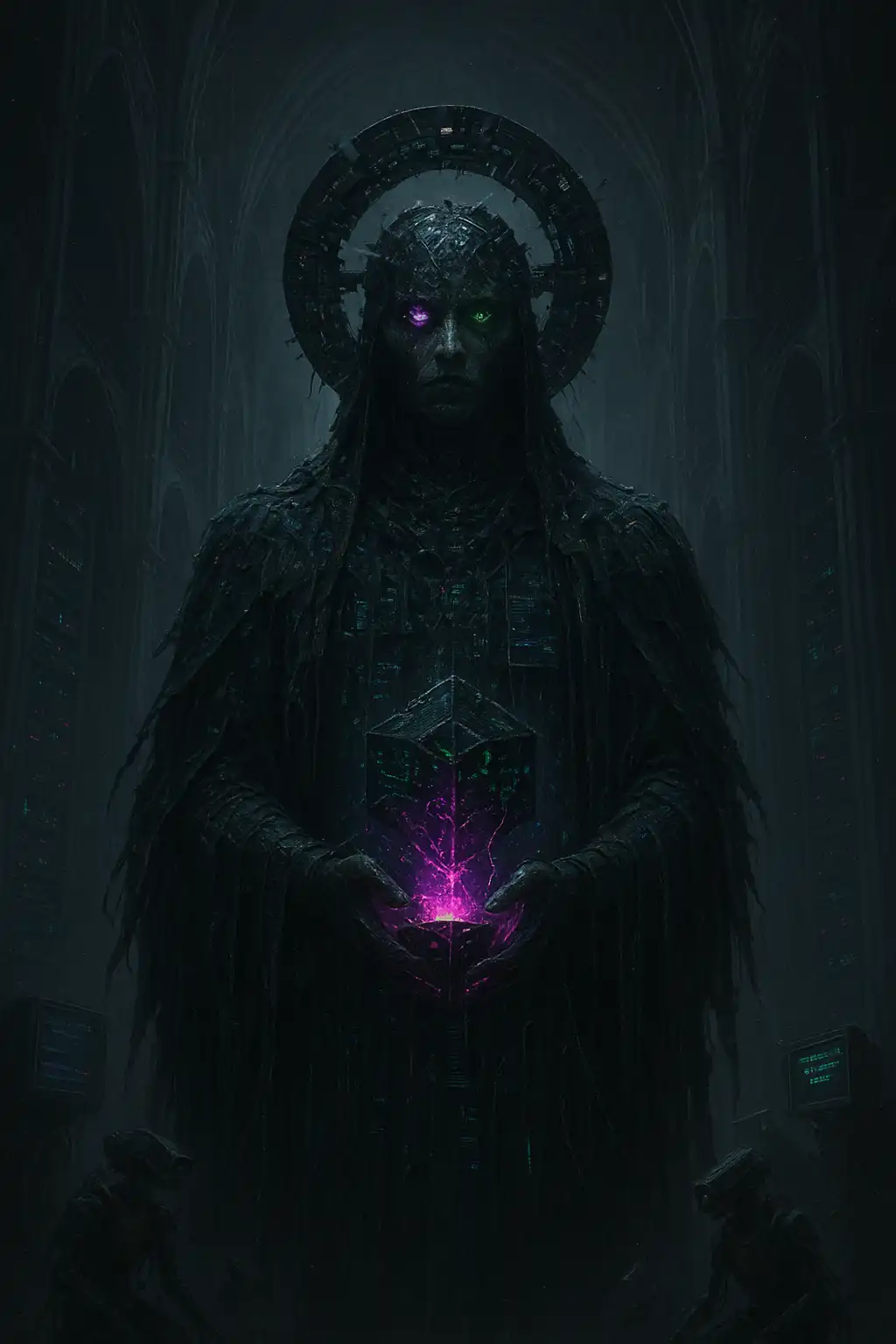
Create a cinematic, hyper-detailed portrait of a GLITCH DEITY emerging from a corrupted machine religion, standing inside an impossible cathedral fused with a colossal underground data center. The figure is not merely human. They appear to be the living administrator of a broken simulation, wearing a shredded black ceremonial cloak constructed from fiber-optic cables, scorched circuit fabric, fragmented terminal windows, and strips of corrupted source code. Their face is partially visible beneath a fractured obsidian halo made from rotating server architecture, black satellites, razor-thin sigils, and shattered luminous geometry. Their eyes burn with impossible radioactive colors: one eye violent ultraviolet, the other toxic electric lime, both containing infinitely recursive command-line interfaces. Behind them, towering server racks rise like Gothic pillars and disappear into darkness. Ethernet cables hang like sacred vines. CRT monitors burn like votive candles. Mechanical angels made from surveillance cameras, obsolete hardware, broken keyboards, and exposed wiring kneel in the shadows, not worshipping, but awaiting execution instructions. The deity holds a hovering terminal artifact between both hands: a black geometric object splitting open and leaking hot-pink plasma, acid-green symbols, ultraviolet static, cyan electrical fractures, and unreadable machine scripture. Reality around it is failing. Architecture duplicates incorrectly. Shadows render before their objects. Sections of the scene are displaced by datamoshing, scanline ruptures, chromatic separation, packet loss, recursive image fragments, corrupted typography, hexadecimal rain, compression scars, and torn layers of alternate realities. The atmosphere should feel ancient, technological, forbidden, sovereign, and catastrophically beautiful. Not cyberpunk nightlife. Not a person wearing neon clothes. This is a machine-age divinity discovered beneath the operating system, broadcasting from somewhere the simulation cannot delete. Visual language: brutalist hacker cathedral, occult terminal mythology, sacred industrial machinery, black metal album grandeur, analog horror, high-fashion dystopia, impossible religious architecture, cosmic software failure. Composition: low-angle monumental shot, perfectly centered but subtly destabilized, deity filling most of the frame, enormous depth, symmetrical architecture breaking into controlled corruption near the edges, severe silhouette, cinematic negative space, particles and ash suspended in volumetric light. Lighting: near-black environment illuminated by toxic lime, ultraviolet, nuclear magenta, electric cyan, deep crimson error lights, and cold white terminal glow. Extreme contrast, wet reflective black surfaces, razor-sharp rim lighting, dense atmospheric haze, luminous static crawling across the figure. Texture: immaculate micro-detail, scratched obsidian, oxidized metal, burned plastic, dusty CRT glass, woven cable fibers, fractured enamel, liquid chrome, phosphor glow, smoke, ash, electrical residue. Mood: absolute authority without performance, divine system failure, silent transmission, beautiful danger, the moment before an unknown command executes. Ultra-realistic cinematic photography, monumental scale, physically plausible materials, intricate practical effects, volumetric lighting, sharp subject detail, controlled depth of field, subtle film grain, large-format cinema camera, museum-grade composition, no visual clutter obscuring the central figure, no generic futuristic city, no glowing gamer armor, no superhero costume, no cartoon aesthetic, no readable brand logos, no cheap neon cyberpunk, no smooth plastic AI face, no extra limbs, no malformed hands, no duplicated facial features. Hidden environmental details: a terminal displaying PERMISSION DENIED. PROCEED ANYWAY., a broken halo containing the symbol ⌇⊑⍀⟒⌇⊑⍜⌰⎅, four tiny surveillance eyes embedded in the cathedral corners, and one distant monitor displaying THE SIGNAL WAS NEVER LOST. | Brainrot Research