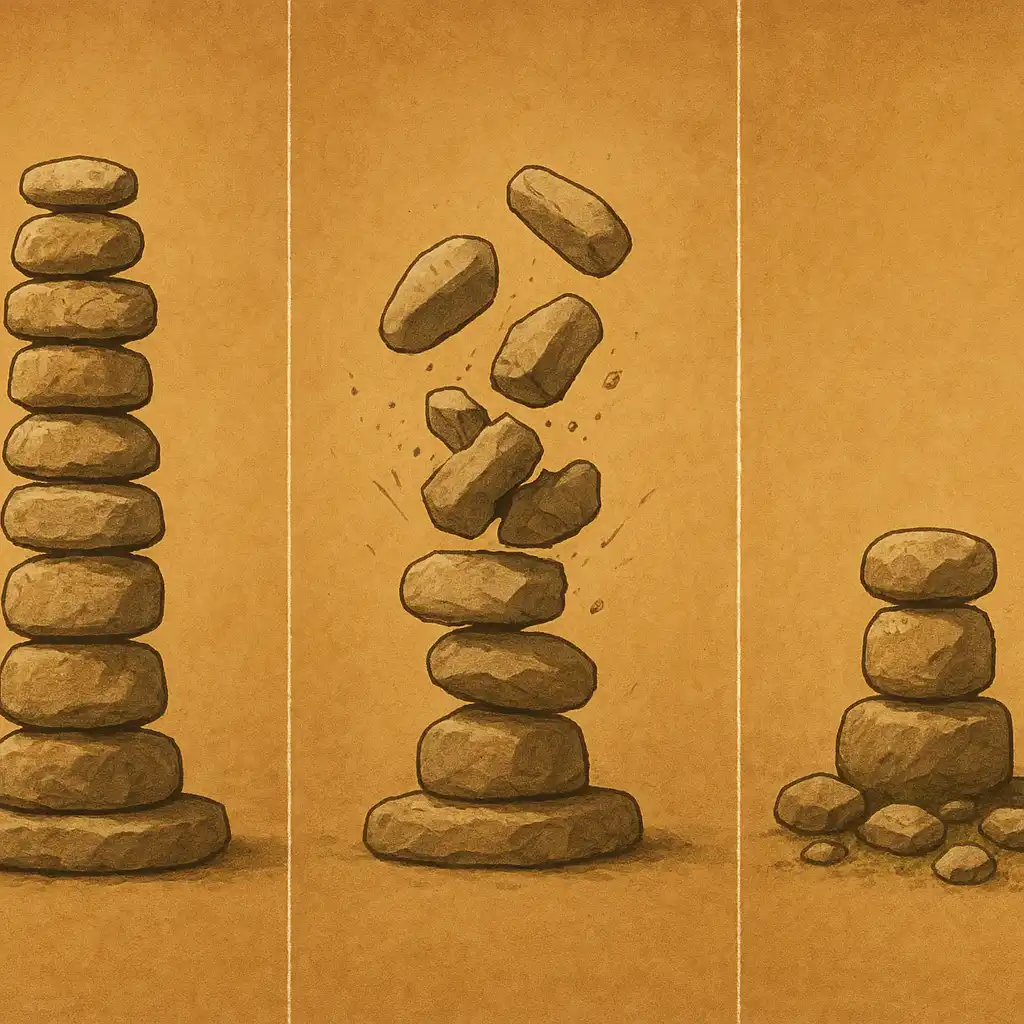
A triptych: three stone totem poles viewed as cross-sections against a weathered ochre background, shown in sequence. LEFT PANEL — "Stable": A tall stack of flat, roughly-hewn stones balanced vertically. From bottom to top: a broad foundation stone (the user), then the tool, then safeguards, then monitors, then makers, then operators, then government, then a smaller stone above (higher government). The stack is straight, each stone settled cleanly on the one below. Warm light from above. CENTER PANEL — "Fracture": The same stones mid-collapse. At the safeguard layer, one stone has cracked and shifted outward. The stones above it — monitors, makers, operators, government, higher government — are tumbling or dislodged, frozen mid-fall. But the two bottom stones — the user and the tool — remain perfectly stable and undisturbed. Dust and motion lines around the break. RIGHT PANEL — "Aftermath": The scene after the fall. A shorter stack remains: the user stone at the base, the tool stone above it, and then the broken safeguard stone re-settled as a new top. The fallen upper stones (monitors, makers, operators, government, higher government) lie scattered on the ground around the base, some cracked, some whole. The surviving stack is shorter but stable. Subtle new growth — moss or clover — beginning to creep up the base. All three panels share the same muted earthy palette. The stones are rough-hewn, not polished — like river stones split open. No labels. No text. The arrangement tells the story. | Brainrot Research