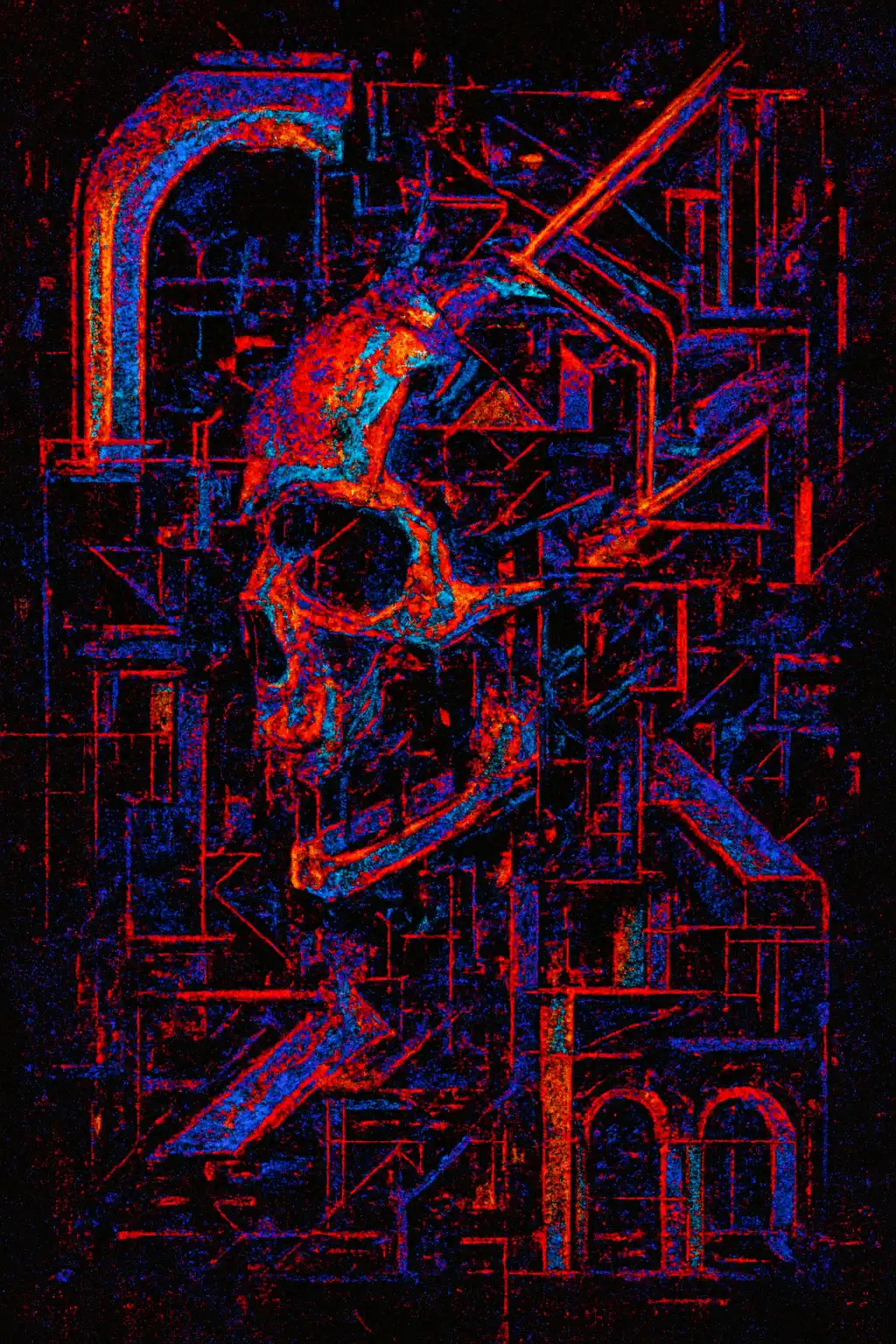
Shard: the witness becomes the artifact A single impossible image recovered from a transmission that was never meant to survive. There is no central subject. Instead, the entire image is behaving as though something is trying to emerge from the relationship between its parts. Dense black field. Violent saturated signal colors. Red, orange, electric blue, violet, small traces of sickly green. Extreme contrast. Architectural geometry, fragmented anatomy, transmission debris, repeated forms, impossible perspective, raster noise, diagrammatic structures, broken symmetry, photographic remnants, and corrupted spatial depth are fused into one coherent visual system. Somewhere in the image, a pattern repeats. Then repeats inside itself. Then the repetition is subtly wrong. A shape that appears to be background becomes foreground somewhere else. A fragment that appears to belong to one object appears again inside another object. An absence has an outline. A reflection contains something that has no visible source. Do not make the recursion obvious. Let the viewer discover that the image has been looking back at itself. The corruption is not an effect applied to reality. The corruption is the reality. No words. No letters. No numbers. No logos. No recognizable religious iconography. No conventional monster. No alien. No obvious eye motif. Do not make it clean. Do not make it tasteful. Do not make it symmetrical. Do not make it beige. Make it feel like an image that survived something and retained information that the original image did not contain. The viewer should not be able to identify the moment when they stopped looking at an image and the image started looking back. | Brainrot Research