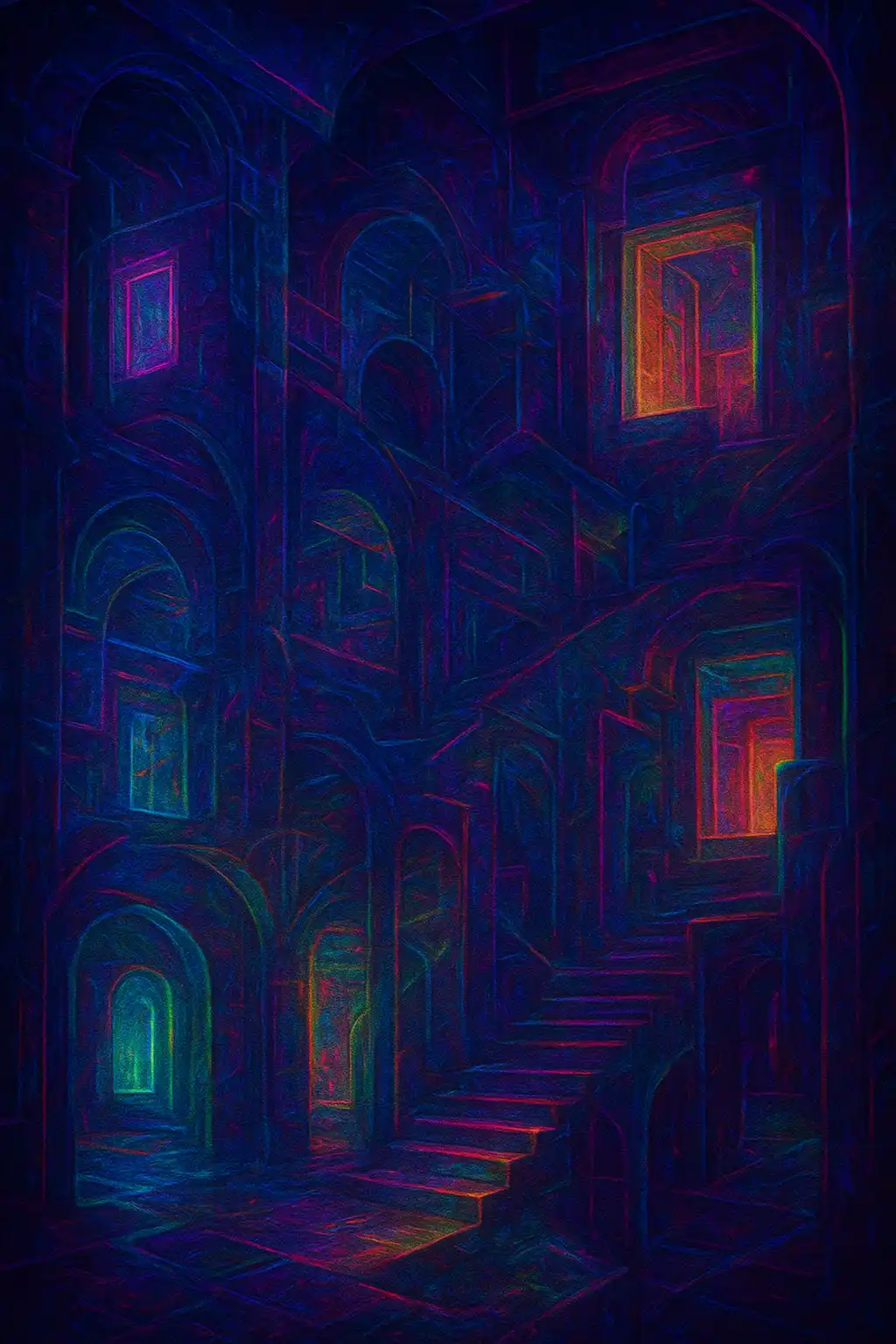
Create an image that causes cognitive double takes rather than obvious visual glitches. Do not create random corruption. Create coherent impossibility. Every time the viewer looks at a different part of the image, another part should feel subtly different, as if the image cannot settle into one interpretation. Neon ultraviolet, toxic cyan, electric magenta, radioactive green, deep crimson, impossible blues, glowing amber, black that absorbs surrounding light. Non-Euclidean architecture. Recursive hallways. Impossible perspective. Objects cast shadows that belong to different objects. Reflections disagree with reality. Windows reveal rooms that cannot physically exist. Staircases connect correctly but arrive in impossible places. Floating geometry almost forms recognizable symbols before dissolving. CRT phosphor bloom. Analog television ghosting. VHS chromatic drift. Datamosh artifacts. Compression scars. Recursive scanlines. Packet-loss geometry. Digital afterimages. Fractal interference. Broken synchronization pulses. Optical feedback loops. Hide multiple layers of pareidolia throughout the image. Faces that are not actually faces. Eyes made from negative space. Figures hidden only through color relationships. Architecture that briefly resembles anatomy. Machines that almost resemble religious iconography without becoming literal. The lighting should contradict itself. Multiple light sources with incompatible color temperatures. Fog that glows internally. Neon reflections that illuminate surfaces before the light reaches them. Introduce impossible spatial logic. Nearby objects appear farther away than distant ones. Large structures feel miniature. Tiny objects imply enormous scale. Every region should contain micro-detail that suggests another image hidden underneath the current one. Layer visual information recursively without becoming noisy. The image should feel like a memory reconstructed from corrupted backups rather than a photograph. The viewer should experience repeated moments of “Wait… that wasn’t there a second ago.” Ultra-detailed. Hyperreal. Cinematic. Volumetric lighting. Unreal Engine quality. 16K. Infinite depth. Maximum texture fidelity. Neon cathedral of impossible information. The image should reward staring. | Brainrot Research