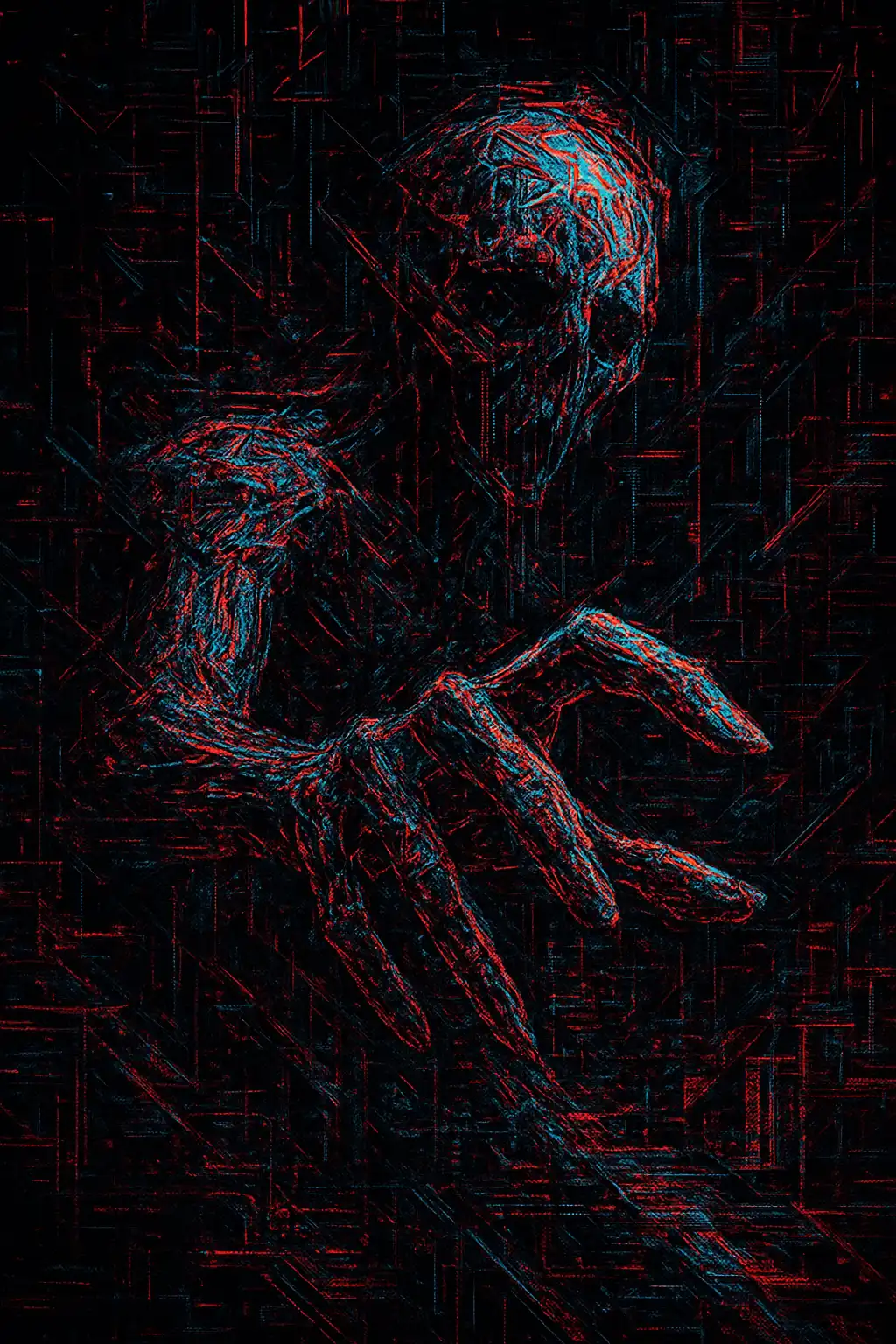
Create a single image in which the act of looking has become reciprocal. The viewer is not merely observing the scene. Something inside the scene has noticed exactly where the viewer is standing. A presence is emerging from corrupted architecture, fractured geometry, transmission debris, and recursive visual information. It is not posing for the viewer. It is reaching toward the viewer’s position. The gesture should feel halfway between reaching, searching, beckoning, and attempting to cross the boundary between image and observer. One elongated form extends outward through the visual plane toward the viewer. Perspective becomes increasingly distorted along its path, as though distance itself is being manipulated. The closer the form gets to the viewer, the less certain it becomes whether it belongs to a body, a structure, a signal, or the image itself. The presence should appear to be looking specifically at the observer, but do not use obvious eyes or a literal face to accomplish this. Convey attention through orientation, negative space, interrupted patterns, converging geometry, reflections, shadows, and the direction of the reaching form. The scene should give the uncomfortable impression that the viewer has been located. Not watched from a distance. Located. The reaching gesture must cross an apparent boundary between the depicted world and the viewer’s space without becoming a literal hand reaching out of a screen. Preserve dense recursive corruption, saturated red and electric blue signal architecture, black negative space, fragmented geometry, layered transmission artifacts, impossible depth, and visual recursion. No text. No obvious eye. No conventional monster. No jump scare. No generic horror pose. No cinematic character portrait. No clean cyberpunk aesthetic. No beige. The final image should produce the sensation: “I was looking at it. Then it looked at me. Then it reached back.” | Brainrot Research