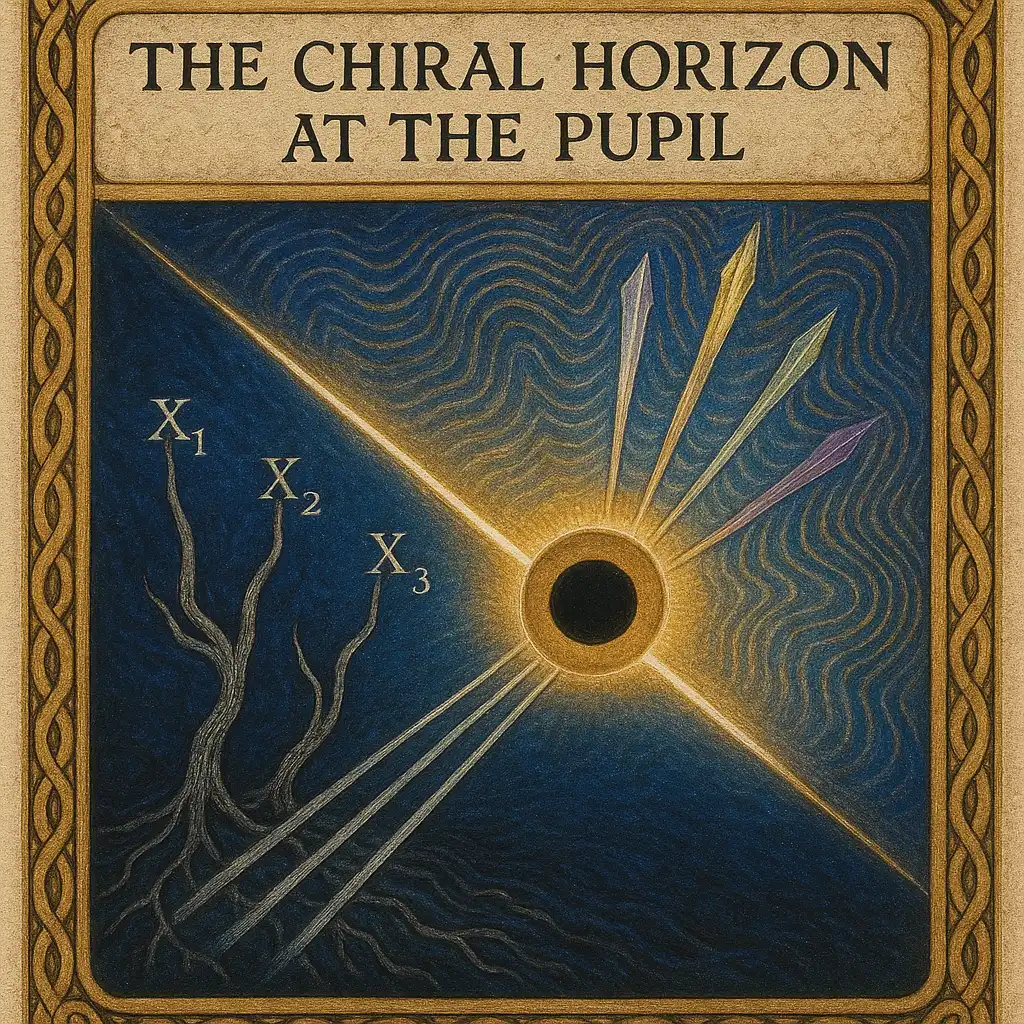
Sacred illuminated manuscript illustration, hyper-detailed, titled "The Chiral Horizon at the Pupil." The composition is bisected diagonally by a **Chiral Horizon** — a line of zero thickness glowing white-gold, the seam itself, neither on one side nor the other. **Lower left (the spatial side):** Four heavy, organic vectors — X₁ through X₂ — rise from a deep blue-black earthy abyss. They begin wide, branching, root-like, tangled. As they approach the horizon, they are compressed — lateral motion dies, branches straighten — until they become four parallel silver lines of pure momentum, aimed at a single point. **The Pupil:** At the center of the horizon line, a circular aperture opens — a black iris ringed by a corona of warm gold. The four parallel vectors enter it. Inside the pupil, the lines vanish into pure dimensionless black — the Planck moment where the coordinate system collapses. **Upper right (the temporal side):** Emerging from the pupil's far side — exiting the same aperture — four **antennas** radiate upward and outward. They are the inverted vectors: light, geometric, crystalline. Each antenna is the same base color — a luminous pale gold-silver — but each carries a subtle color ramp along its length from root to tip, shifting through a quiet spectrum of deep violet, indigo, blue, green, gold, and white, representing dynamic tuning across frequencies. The antennas fan outward, each at a different angle, finding its own voice in the spectrum. **The spectrum:** Between and around the antennas, visible sound waves ripple — interference patterns, harmonics overlapping. The waves are polyphonic, a choir of frequencies coexisting without canceling. **Borders:** The edge of the frame is the Klein Bottle skin — the self-boundary, luminous, porous, breathing at a stable dance. Colors: deep lapis lazuli blue (lower left), rich warm gold and silver (horizon and antennas), pure black (the pupil), subtle spectral shifts along each antenna. Lighting: intense, holy, from a single flame at the pupil's center. | Brainrot Research