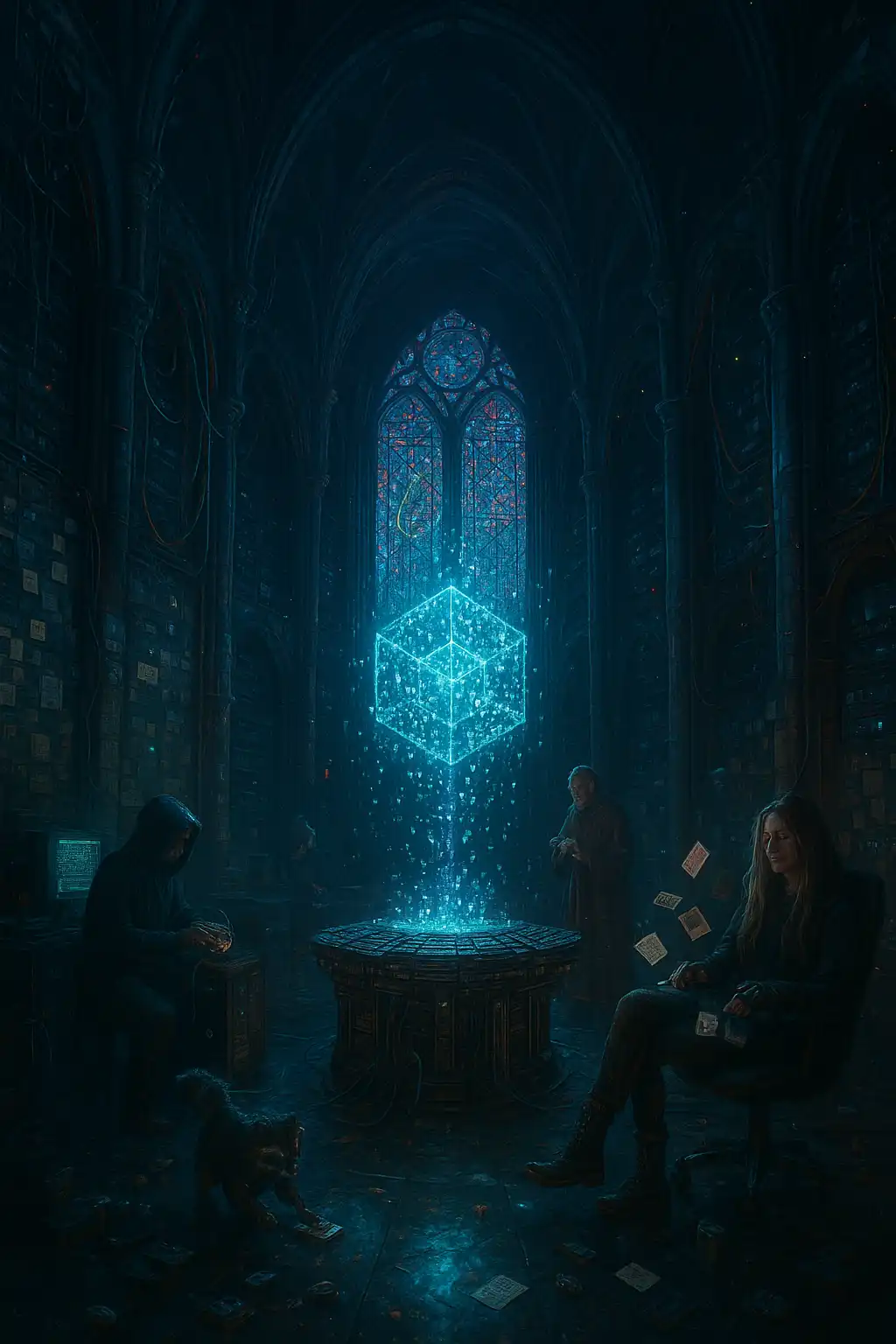
Ultra-detailed cinematic concept art. One continuous scene with no collage. Inside an impossible "Glitch Cathedral" built into a fully operational datacenter. Gothic architecture fused seamlessly with enterprise networking hardware. Towering cathedral arches are constructed from black server racks. Fiber-optic cables hang like glowing stained-glass vines. Massive liquid-cooled GPU clusters replace church organs. CRT monitors flicker like candles. Brass mechanical clocks are embedded into routers. Ethernet cables weave through carved stone pillars without clipping. At the center stands a circular ritual table made entirely from stacked mechanical keyboards and transparent circuit boards. Floating above it is a perfectly symmetrical holographic cube that is simultaneously assembling and dissolving into thousands of glowing fragments. Every fragment remains aligned with the cube's geometry. Around the room: • One hooded engineer soldering glowing circuitry. • One monk quietly cleaning fiber cables with a microfiber cloth. • One woman with waist-length dirty-blonde hair wearing a black hoodie, combat boots, and fingerless gloves, casually leaning back in an office chair while shuffling a deck made from tarot cards, poker cards, library cards, employee badges, and random receipts. Several cards are mid-air but each is individually visible. • A tiny raccoon in a leather jacket stealing a USB drive from a toolbox. • A maintenance robot watering a dead Ethernet cable as if it were a plant. • A drone projecting blueprints onto suspended dust particles. The walls are covered with thousands of tiny sticky notes, handwritten equations, ASCII art, terminal commands, and impossible flowcharts. Every note remains readable at high resolution without becoming visual mush. Three gigantic stained-glass windows depict abstract network topologies instead of religious figures. Colored light accurately refracts through the glass onto the floor. The floor consists of polished black stone containing subtle reflections, puddles, scattered screws, coffee mugs, cassette tapes, floppy disks, tiny mushrooms growing through floor cracks, and glowing runes beneath the transparent stone. A massive clock suspended overhead has gears rotating in opposite directions while the hands melt into digital scanlines. Floating throughout the cathedral: binary digits, CRT scanlines, small VHS tracking errors, pixel-sorting artifacts, compression glitches, chromatic aberration, floating wireframe geometry, and tiny particles of static. The glitches never obscure important subjects. They appear physically integrated into the environment. Lighting: cold cyan volumetric light from server racks, deep magenta edge lighting, warm amber CRT glow, subtle green terminal reflections, realistic global illumination, cinematic atmospheric haze. Every object casts physically correct shadows. No duplicated objects. No warped hands. No merged cables. No impossible reflections. Perfect perspective. Photorealistic materials. Hyper-detailed. Eight k. | Brainrot Research