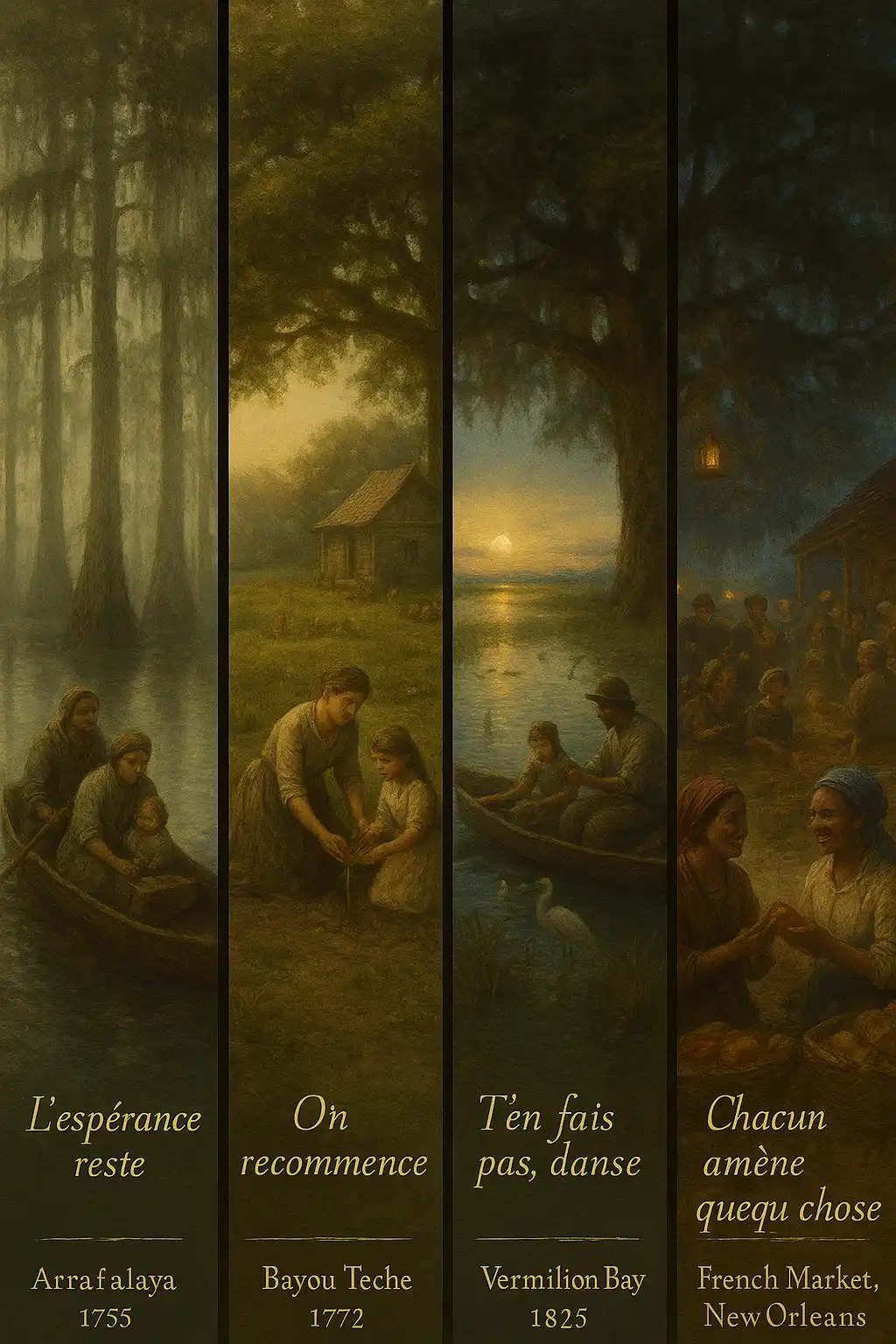
Create a wide 16:9 panoramic historical artwork divided into exactly five equal vertical panels, separated by four thin, straight, dark vertical divider lines.The composition must read from left to right as five chapters of one Louisiana story, progressing chronologically from 1755 to 1860.Use romantic historical realism, resembling a finely painted nineteenth-century illustrated history book: realistic anatomy and faces, softly painterly brushwork, atmospheric depth, luminous natural light, rich but slightly aged colors, fine detail, subtle canvas texture. The five panels must share the same artistic style, rendering quality, perspective language, and visual weight.Each panel contains one French phrase positioned along the bottom, centered horizontally, written in elegant antique cream-gold cursive script. The phrases must be reproduced exactly as written, with no English translations, no titles, no dates, and no other text.PANEL 1: ATCHAFALAYA BASIN, 1755 Deep misty Louisiana cypress swamp at dawn. Extremely tall bald cypress trees rise vertically through the composition, draped heavily in Spanish moss. Dark glasslike water reflects the trees and pale golden sunrise.In the lower center, a small handmade wooden pirogue carries an Acadian family: mother, father and young children dressed in simple, worn mid-eighteenth-century clothing. Their few possessions include a small wooden trunk and a wrapped fiddle. They appear tired but calm, traveling deeper into the landscape.Dominant colors: charcoal green, muted blue-gray, pale mist and distant amber sunlight.Bottom inscription: L’espérance reste. PANEL 2: BAYOU TECHE, 1772 Warm early morning beside Bayou Teche. A huge spreading live oak dominates the upper half of the panel. Beneath it stands a tiny hand-built cypress Acadian house with a steep wooden roof.A vegetable garden fills the middle ground. Chickens wander freely. A man works beside a wooden pirogue near the water.In the foreground, an Acadian mother kneels beside her young daughter as together they plant a small green sapling into dark Louisiana soil. This panel should communicate permanence beginning to emerge from uncertainty.Dominant colors: warm green, cypress brown, soft gold and fertile earth. Bottom inscription:On recommence. PANEL 3: VERMILION BAY, 1825 An expansive Louisiana coastal marsh at brilliant sunrise.The glowing sun sits low near the horizon and reflects as a long golden path across calm water. Marsh grasses break the distant horizon. Egrets, herons and pelicans inhabit the shallow water.In the foreground, a Cajun father and young daughter work together from handmade wooden pirogues with a traditional fishing net. The father gently releases one small fish back into the water while the girl watches. This is the brightest panel in the entire artwork, visually forming the luminous heart of the composition.Dominant colors: luminous gold, pale blue, cream and marsh green.Bottom inscription:L’eau nous nourrit. PANEL 4: ST. MARTINVILLE, 1845 Blue hour beneath enormous live oak trees draped with Spanish moss.A modest wooden Louisiana home sits along the left background. Several warm amber lanterns hang from the porch and oak branches.A Cajun fiddler plays while an entire small community dances informally on packed earth.At the visual center, a young woman in a simple pale nineteenth-century dress spins joyfully with her skirt moving around her. Men and women clap and dance around her. Older people and children participate naturally. Reflections of lanterns and dancers shimmer in small rain puddles beneath their feet.The first tiny stars appear through the live-oak canopy.Dominant colors: midnight blue, deep green, warm amber and candlelight. Bottom inscription: T’en fais pas, danse. PANEL 5: FRENCH MARKET, NEW ORLEANS, 1860Bright bustling morning at the nineteenth-century French Market beside the Mississippi River. Historic market buildings frame both sides of the composition. Produce, fish, bread and goods fill wooden tables and woven baskets.Show the multicultural population of historic New Orleans naturally throughout the market, including Black and Creole vendors, European immigrants, Indigenous traders, sailors, city residents and visiting Acadians. In the foreground, two women from different Louisiana communities smile warmly while exchanging small pieces of food from their hands, representing cultural exchange rather than assimilation.Beyond them, the Mississippi River is visible with historically appropriate nineteenth-century steamboats. Dominant colors: warm terracotta, cream, blue, ochre and bright Louisiana daylight.Bottom inscription: Chacun amène quéque chose. EXACT COMPOSITIONAL REQUIREMENTS Exactly five panels, no more and no fewer. All panels are identical in width.Four thin dark vertical lines clearly separate them. Do not blend people or buildings across panel boundaries.Maintain a continuous visual rhythm through water, horizon, vegetation and changing Louisiana light. Human figures should remain intimate within large environments. Louisiana itself is the principal character.Avoid glamour photography, fantasy elements, modern clothing, modern boats, modern buildings, Mardi Gras imagery, plantation mansions, exaggerated poverty, stereotypical Cajun costumes, text other than the five specified French phrases, decorative borders, maps, flags, labels or dates. Most important: preserve the sense that these are not five heroic historical events. They are five glimpses of ordinary people living ordinary lives across a century of Louisiana history.The final image should feel like five surviving pages from the same beautifully illustrated Louisiana family history placed side by side. | Brainrot Research